REVIEW · BOHEMIA
Canoeing on the Elbe river from Děčín to Bad Schandau
Book on Viator →Operated by Active Point Decin · Bookable on Viator
Rowing your way through sandstone canyons feels unreal.
This 22 km Elbe canoe trip is a simple, hands-on route from Kemp Děčín to the spa town of Bad Schandau, passing major viewpoints on the way out of Děčín. I especially like that you get the full setup up front—canoe/kayak, paddle, life jacket, and a dry bag—so you can focus on the water instead of logistics.
The scenery is the main event: you cruise from Děčín past the Shepherd’s Wall area and then into the sandstone canyon stretching through Bohemian and Saxon Switzerland national parks. One drawback to consider: one participant reported too little instruction and no German-speaking staff at the end, with trouble arranging a return. If language support matters to you, plan to check ahead.
In This Review
- Key highlights to know before you go
- Canoeing the Elbe: Děčín to Bad Schandau’s real payoff
- Start at Kemp Děčín: what the handover actually means for you
- The 4.5-hour paddle plan: pacing, views, and when to pay attention
- Leaving Děčín: Shepherd’s Wall and the Děčín chateau on the opposite bank
- Through Bohemian and Saxon Switzerland: why the sandstone canyon section is the star
- Bad Schandau handover: the train-station convenience you’ll appreciate
- Price and value: what $17.42 really buys you
- What to bring (and what to avoid) for a smoother paddle day
- Language and instruction: a real consideration from past participants
- Who should book this Elbe canoe trip (and who might not)
- Booking timing and weather: keep your plans flexible
- Should you book canoeing from Děčín to Bad Schandau?
- FAQ
- How long is the canoe trip from Děčín to Bad Schandau?
- How far will I paddle?
- What gear is included?
- Where do I start and where do I finish?
- How do I get back after I reach the end point?
- What happens if the weather is bad?
Key highlights to know before you go
- 22 km in about 4.5 hours at a pleasant pace, so you’re not sprinting downstream
- Small group size (max 5), which can make the handover and quick guidance smoother
- Děčín to Bad Schandau by canoe, then you can return by train right by the endpoint
- Sandstone canyon + national parks energy, crossing from Czech to Germany
- Gear included: life jacket, dry bag, paddles, and an original map
- Weather dependent: you’ll want a clear day, since the trip may be rescheduled or refunded
Canoeing the Elbe: Děčín to Bad Schandau’s real payoff
If you want a “works great in real life” kind of day, this paddle fits. You’re on the Elbe for roughly 4 hours 30 minutes, covering 22 km with a pleasant pace. That timing matters because it gives you room to look up at the cliffs, stop when you need to, and still feel like you got a full experience—not a quick taster.
The route’s personality is what sells it. You start in Czechia with Děčín’s riverside views and historic backdrops, then you float into a dramatic sandstone canyon zone that runs through Bohemian Switzerland and Saxon Switzerland. This is the kind of terrain that makes you look at the river as a corridor, not just a channel.
And then there’s the ending: Bad Schandau is a real place, not an anonymous dock. You’ll reach a handover point right by the ferry and train station, so you can choose a short stroll into town for restaurants and cafes or go straight back. That flexibility is practical and honestly saves time if you’re planning more than one thing in the region.
A few more Bohemia tours and experiences worth a look
Start at Kemp Děčín: what the handover actually means for you
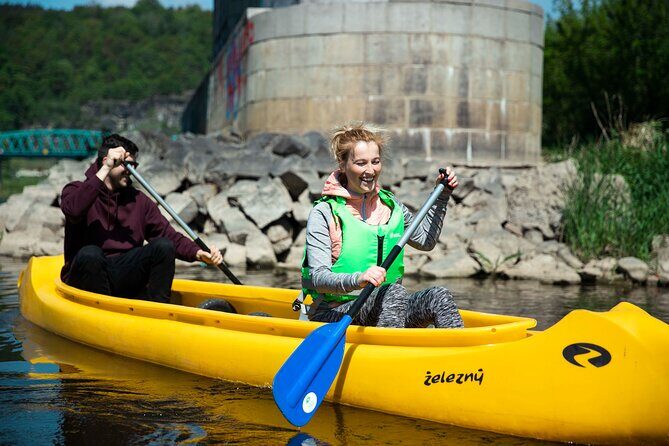
Your trip begins at Kemp Děčín (Kemp DěčínPolabí, Děčín-Děčín 2). On arrival, you’ll be given your canoe or kayak, plus paddles, a life jacket, and a dry bag. There’s also a short, on-site briefing.
Why I think this matters: for many river trips, people get stuck doing paperwork or figuring out gear setup. Here, the emphasis is on getting you into the boat quickly with instructions in boat manoeuvring. It’s not described as an all-day class, so treat the briefing as the basics—enough to get moving safely and confidently.
Group size is listed as maximum 5 travelers, which is usually a good sign. Fewer people often means you’ll spend less time waiting around and more time actually on the water. You also receive a mobile ticket, which is convenient if you don’t want to juggle printed papers.
The 4.5-hour paddle plan: pacing, views, and when to pay attention
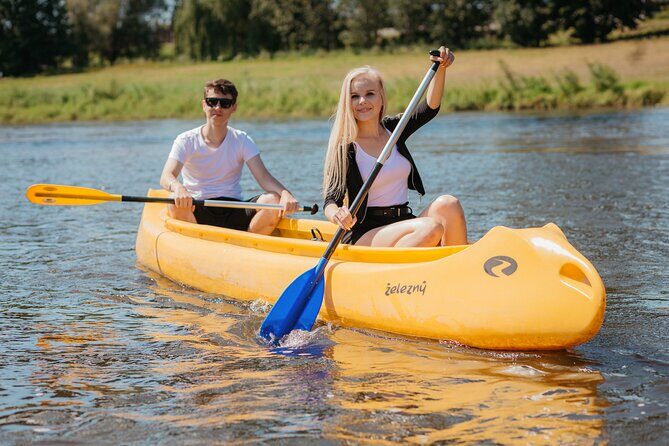
The core of this experience is straightforward: paddle 22 km from Děčín toward Bad Schandau, with a total duration of about 4 hours 30 minutes. The wording points to a pleasant pace, so you’re not expected to power through like it’s a race.
Here’s what you can mentally plan for:
- Early stretch from Děčín: this is when you’ll notice the big visual landmarks
- Middle stretch through the canyon: this is when you’ll want to focus on steering, watching your line, and soaking in the sandstone walls
- Approach to the handover point in Germany: you’ll want to be ready to stop and disembark cleanly when it’s time
One key detail: the handover point is on a small beach on the left bank, before the first bridge you’ll see in Germany, near the ferry and train station Bad Schandau. When you reach that area, the organization takes back the boat and all the equipment.
I’d treat the final part as a moment to slow down your decision-making. Not because the trip sounds risky, but because the handover is time-efficient by design. You’ll have to be ready to get out, with your dry bag secured and your timing aligned.
Leaving Děčín: Shepherd’s Wall and the Děčín chateau on the opposite bank
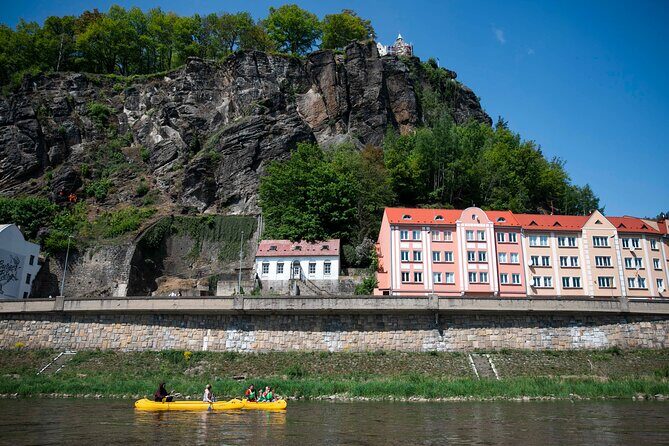
Right after you set off from Děčín, the route makes a promise: you’ll get impressed by what’s around you. On the way out, you’ll face the Shepherd’s Wall area, which is associated with a Via Ferrata, while the Děčín chateau rises above the river on the other side.
This is a great reminder of what river paddling does well: it compresses viewpoints into something you can actually experience at water level. You’re not just looking at cliffs from a road or a viewpoint tower. You’re moving alongside them, and they change shape as you pass.
Also, this is the moment to get your paddle rhythm going. The first section is where mistakes are easiest to correct. If you start calm and steady, the rest of the trip feels smoother.
Through Bohemian and Saxon Switzerland: why the sandstone canyon section is the star
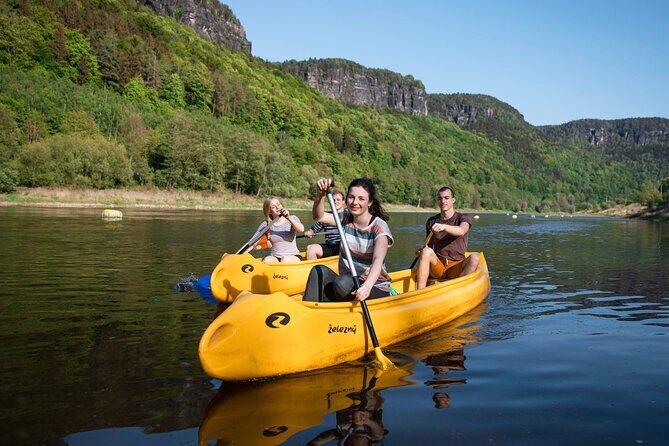
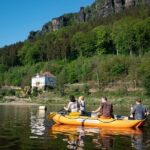
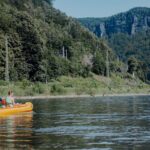
After the initial departure, the Elbe brings you into a majestic sandstone canyon through national parks on both sides of the border: Bohemian Switzerland in Czechia and Saxon Switzerland in Germany.
Even if you’ve never visited either park, you’ll understand what people mean by “sandstone scenery” in minutes. As you go, the cliffs and rock formations create natural-looking walls that guide your attention downstream. It’s the kind of environment where you’ll occasionally want to stop paddling just to look around, even if only for a few seconds.
From a practical standpoint, canyon segments also mean you’re more aware of your line. Closer walls can make turns feel sharper. So if you’re still getting used to the boat, keep your strokes steady and avoid over-correcting.



Bad Schandau handover: the train-station convenience you’ll appreciate
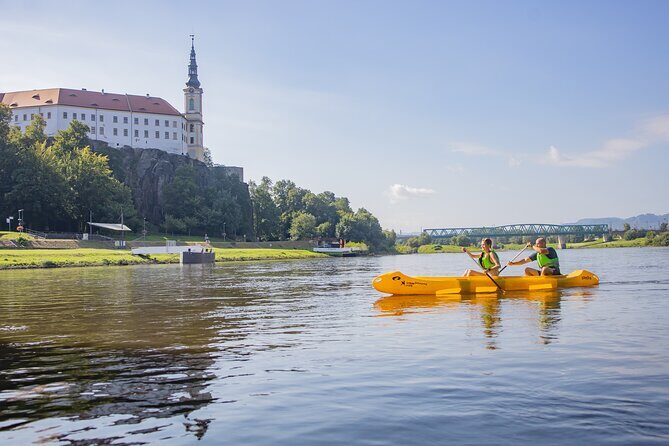
The end of your paddling isn’t a complicated scavenger hunt. You reach the handover point near the ferry and train station Bad Schandau, and the meeting details emphasize convenience: the train station is directly across the street, with less than 5 minutes walking back.
Two ways you can use that time:
- If you want a break in town: you can visit the center of Bad Schandau, with restaurants and nice cafes
- If you want to keep the day simple: you can go straight back to Děčín from the nearby station
Just note one important financial line: personal transportation back to Děčín is not included. The good news is the station is right there, so the missing piece is on you, not on complicated logistics.
And remember the gear return: you hand in the boat and equipment at the endpoint handover point. Plan to keep everything organized so your last moments aren’t stressful.
Price and value: what $17.42 really buys you
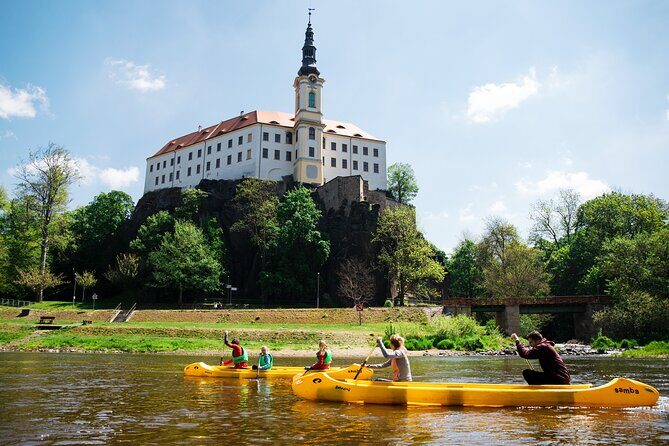
At $17.42 per person, this is priced like an affordable way to get on the water. The value comes from what’s included rather than from what’s optional.
Included:
- Rental of canoe/kayak
- Paddles, life jacket, and dry bag
- Transportation of the equipment
- Instructions in boat manoeuvring
- Original map
Not included:
- Personal transport back to Děčín
- Transport baggage
That inclusion list is the heart of the value. If you’ve ever tried to rent boats, you know how quickly costs and time add up once you factor in equipment handling. Here, you show up, get outfitted, and the equipment moves with the operation.
The main value question for you is this: do you want a calm, scenic 22 km experience with light instruction, or do you want a highly guided, commentary-heavy outing? This sounds like it’s focused on getting you paddling and letting the river do the talking. If that’s your style, the price makes sense.
What to bring (and what to avoid) for a smoother paddle day
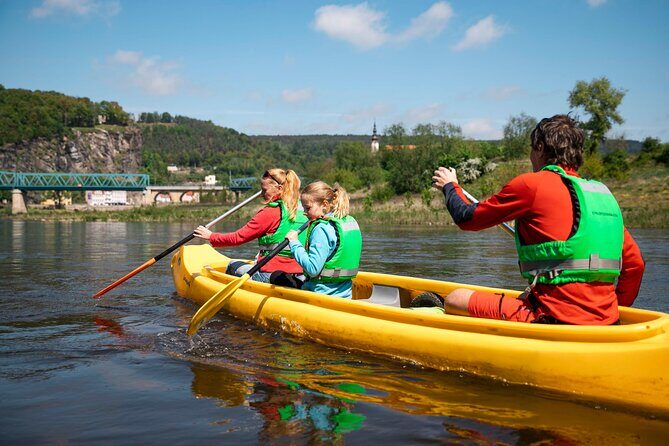
The trip includes a dry bag, which helps you protect essentials, but it doesn’t make you invincible. I’d treat this day like a “you will get wet eventually” activity, even if the dry bag does its job.
Practical approach:
- Bring something you’re happy to have damp near the end of the paddle
- Keep valuables in the dry bag, and don’t cram it in a way that makes it hard to seal
- Dress for warm weather and sudden cool river air, since the water can feel different than the land
- Bring a bit of patience for the short on-site briefing—then ask questions immediately if anything is unclear
Also, a note on fitness: travelers should have a moderate physical fitness level. That doesn’t mean you need to be an athlete; it means you should be comfortable paddling for a few hours and getting in/out at the endpoint.
Language and instruction: a real consideration from past participants
With a rating of 3.4 (5 reviews), this isn’t a “perfect score every time” experience. One written report specifically flags a problem: almost no instruction, no German-speaking staff at the endpoint, and the participant says they were left there with no return option with the organizer.
I can’t generalize that to every departure, but you should take it seriously. If you don’t speak the local language well, or if you need extra reassurance at the end, do two things:
- Ask beforehand what language the staff at the endpoint uses, and how they handle communication
- Plan your return independently from the station area, since your personal transport back to Děčín isn’t included
This kind of planning turns a potential stress point into a non-issue.
Who should book this Elbe canoe trip (and who might not)
This trip fits best if you want:
- A scenic river day without complicated planning
- A manageable paddle distance of 22 km over about 4.5 hours
- A small group experience (max 5 travelers)
- The convenience of ending near the Bad Schandau train station
It might be less ideal if you want:
- A long, detailed guide-led lecture throughout the entire trip
- A guaranteed language match at the endpoint
- A service that includes your full round-trip transportation from start to finish, since the return to Děčín isn’t included
If you’re traveling solo, as a couple, or with a small group of friends, this sounds like an easy match. If you’re with people who dislike water time or aren’t comfortable with moderate physical effort, you may want to look for a shorter route.
Booking timing and weather: keep your plans flexible
The experience notes that it requires good weather. If it’s canceled due to poor weather, you’ll be offered a different date or a full refund.
Because it’s typically booked about 27 days in advance on average, I’d treat it as something to secure once your weather window looks decent. That said, since options exist if it gets canceled, it’s not the kind of gamble where you’re stuck.
When the day is good, you’ll feel like you chose the right kind of “active travel.” When it isn’t, at least the operation has a clear weather policy.
Should you book canoeing from Děčín to Bad Schandau?
I’d book this if you want a practical, scenic canoe day where the hard part (gear and river routing) is handled for you. The combination of 22 km, 4.5 hours, and the dramatic Elbe sandstone canyon through national parks is a strong payoff for the money. Plus, ending near the Bad Schandau station makes it easy to keep the rest of your day moving.
I’d think twice or at least plan more carefully if you strongly rely on language support or if you need reassurance at the endpoint. The one negative report about weak instruction and lack of German-speaking staff at the end is the only red flag you should weigh.
If you like calm competence, scenic paddling, and a straightforward finish with train access, this is a great way to experience the Elbe between Czech and Germany.
FAQ
How long is the canoe trip from Děčín to Bad Schandau?
It takes about 4 hours 30 minutes.
How far will I paddle?
The trip covers 22 km at a pleasant pace.
What gear is included?
You get a canoe or kayak, a paddle, a life jacket, and a dry bag. The tour also includes instructions in boat manoeuvring and an original map.
Where do I start and where do I finish?
You start at Kemp Děčín (Kemp DěčínPolabí, Děčín-Děčín 2). The trip ends back at the meeting point, and equipment is handed over at the endpoint near the ferry and train station Bad Schandau.
How do I get back after I reach the end point?
The train station at Bad Schandau is directly across the street, less than 5 minutes walking from the endpoint. Personal transportation back to Děčín is not included.
What happens if the weather is bad?
This experience requires good weather. If it’s canceled due to poor weather, you’ll be offered a different date or a full refund.