REVIEW · PRAGUE
Walking tour of Prague in French : Nové Město
Book on GetYourGuide →Operated by Prague Découverte · Bookable on GetYourGuide
Prague’s Nové Město rewards slow walking. In this French tour you’ll learn how Charles IV planned the district in 1348, then connect that idea to today’s architecture and river views. I particularly love the way the guide ties city layout to real places, and how the stops mix Gothic, Baroque, Art Nouveau, and Cubist landmarks without making it feel like a lecture; one possible drawback is the route is outdoors, so you’ll need to be ready for rain, shine, or snow.
I also like that you get a clear structure with short guided talks at each point, so you’re not stuck listening for hours in one place. The pacing works well for first-timers who want the big themes of Czech culture (including references to the Prague Spring) while still getting photo stops along the Vltava.
In This Review
- Key things that make this Nové Město tour worth it
- Why Nové Město Works as a Walking Route
- Price and what you get in 2.5 hours (French-language tour)
- Meeting at Jindřišská Tower: getting oriented fast
- Senovážné to Wenceslas: the market-city idea behind Nové Město
- Stop 2: Senovážné náměstí
- Stop 3: Na Příkopě 864
- Stop 4: Náměstí Republiky
- Stop 5: Ovocný trh
- Stop 6: Václavské nám. 826 (Wenceslas Square area)
- Stops 7: Jungmann Square
- Franciscan Gardens to David Černý: architecture with a modern wink
- Stop 8: Franciscan Gardens, Prague
- Stop 9: Sculpture David Černý (Kun)
- Stop 10: Wenceslas Square
- Stops 11 to 12: Sokolská 1595/62 and Na Rybníčku
- Charles Square to the river: Gothic and Baroque energy, then Vltava photos
- Stop 13: Charles Square
- Stop 14: Resslova
- Stop 15: Masarykovo nábřeží
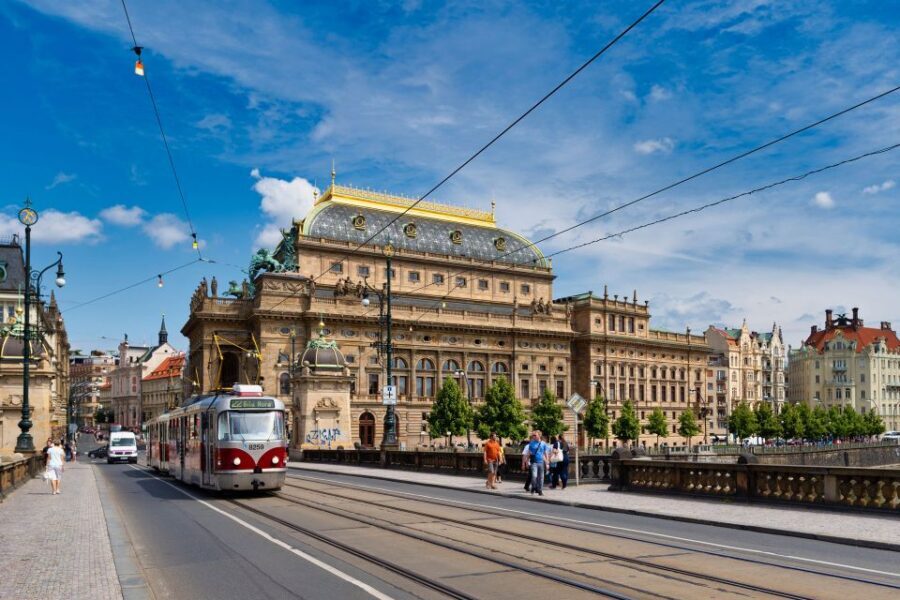
- Stop 16: Prague National Theatre
- The Vltava and Archer’s Island photo segment
- Legion Bridge to Park Legií: finishing with views
- Stop 17: Legion Bridge
- Stop 18: Park Legií
- How to plan your day around this walking tour
- Who should book this Nové Město walk
- Should you book this tour or not?
- FAQ
- What language is the tour in?
- How long is the walking tour of Nové Město?
- How much does it cost?
- Where do I meet the guide?
- What’s the easiest public transport to reach the meeting point?
- Where does the tour end?
- Is the tour indoors?
- What’s included and what’s not included?
Key things that make this Nové Město tour worth it
- A French-speaking guide with a Czech Ministry of Tourism–licensed local background
- Three planned “market centers” explained through Charles Square, Wenceslas Square, and Senovážné náměstí
- Architecture variety on foot, from major civic and cultural buildings to newer landmarks
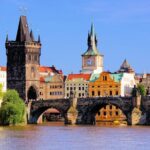
- Vltava quays plus Archer’s Island for classic Prague river photos
- David Černý’s Kun sculpture included as a quick, memorable stop
- Photo-friendly timing, with multiple short breaks where the guide builds in viewpoints
Why Nové Město Works as a Walking Route
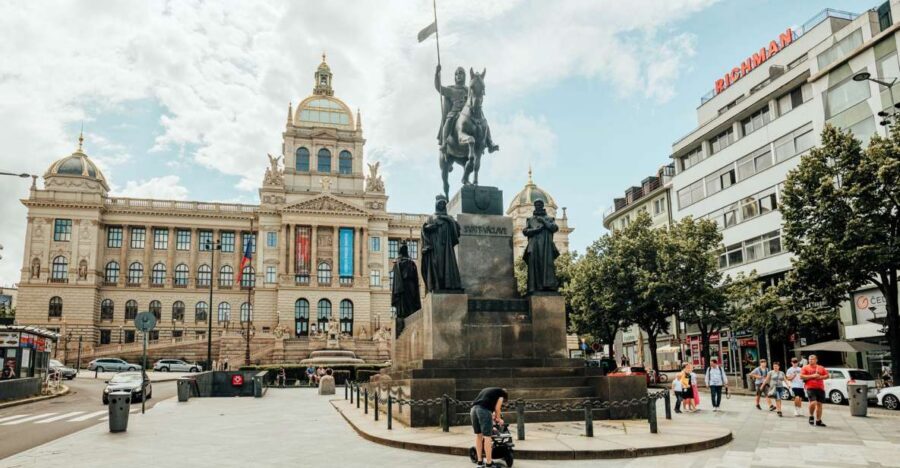
Nové Město is the part of Prague that feels like it was designed with a plan, not just grown over time. Here, you’re walking through an area laid out in the 14th century under Charles IV (1348), then matured around three central “market” hubs: cattle at Charles Square, horses at Wenceslas Square, and hay at Senovážné Square.
That matters because it changes how you experience the city. Instead of only seeing famous buildings, you start seeing the logic behind them: why streets line up the way they do, why certain squares play bigger roles, and why later eras left their marks right on top of the original urban idea. If you like Prague as more than postcard scenery, this is a strong way to do it.
The tour also covers the river side of the story, so you’re not trapped in stone squares all day. By the time you reach the Vltava quays and Archer’s Island, Prague feels less like museum rooms and more like a working city with viewpoints you’ll actually want to remember.
You can also read our reviews of more walking tours in Prague


Price and what you get in 2.5 hours (French-language tour)
The tour price is $27 per person, for about 2.5 hours of guided walking in French. On paper, that’s simple. In practice, it’s good value because the ticket includes more than just a route: you get a licensed local guide, explanations focused on Prague history and Czech culture, plus tips on where to go next.
What’s especially worth your attention is the mix of time and topic. Many tours throw you between landmarks with minimal context. Here, the talks are broken into short guided moments at each stop, so the “why it matters” keeps showing up as you walk, not only at the beginning or end.
Two small budgeting notes: transport tickets and food/drinks are not included. Also, there’s no hotel pickup, so you’ll need to get yourself to the meeting point on your own.
Meeting at Jindřišská Tower: getting oriented fast
You’ll meet in front of the entrance of Jindřišská věž (Jindřišská Tower). The easiest way to reach it is by tram from Jindřišská station, served by lines 3, 5, 6, 9, 14, and 24.
This is a smart start point if you want to build bearings quickly. You begin in the center of the “new town” area, and from there the route keeps moving through the squares that define Nové Město’s planning. It’s also a good option if you’re juggling multiple activities in Prague, because you’re not stuck crossing the city first.
One extra practical detail: the itinerary lists the finish at Park Legií, while the activity info also says the tour ends back at the meeting point. Since those two things conflict, I’d treat it as a “confirm in your booking details” situation so you don’t get surprised when you’re planning the rest of your day.
Senovážné to Wenceslas: the market-city idea behind Nové Město
This is where the tour starts showing you the district’s core logic. Your early stops are built around squares and streets that help explain the 14th-century urbanism Charles IV launched in 1348.
Stop 2: Senovážné náměstí
Senovážné náměstí is one of the three named centralities: the hay market. Expect your guide to use this stop to frame how the “new town” was organized around market life, not just monuments. It’s a good moment to get your mental map straight, because later stops will keep referring back to this organizing idea.

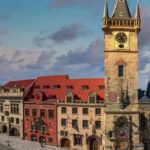
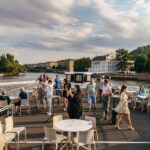
Stop 3: Na Příkopě 864
After the first square, you move into the street fabric. This is the part of the tour where walking matters: you learn how district planning shows up in the way streets connect and how different buildings create a changing street rhythm.
Stop 4: Náměstí Republiky
This stop comes with a longer 15-minute guided segment, which signals it’s meant to be a “slow down and compare” moment. Here you’ll get more of the architecture story, including how later centuries layered distinct styles onto the original plan.
Stop 5: Ovocný trh
Ovocný trh adds another layer to the market-and-square pattern. Even if you’re not hunting every building detail, it’s a place to notice how Prague’s public spaces keep pulling you in different directions.
Stop 6: Václavské nám. 826 (Wenceslas Square area)
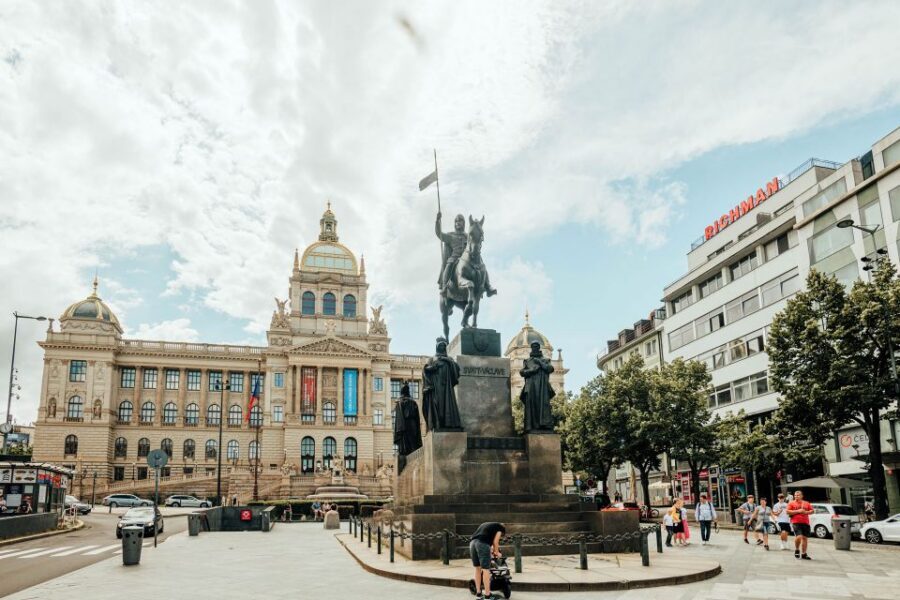
Wenceslas Square is the horse market. As you reach this area, the tour becomes more than history: it starts helping you interpret what you’re seeing in terms of Czech identity and the city’s cultural evolution.
Stops 7: Jungmann Square
Jungmann Square is short but useful. Think of it as the “bridge stop” where the guide’s talk helps connect the square themes to what’s coming next—especially the shift from market planning to artistic and cultural landmarks.
Franciscan Gardens to David Černý: architecture with a modern wink
After you’ve got the planning story, the tour starts balancing it with style. That’s one of the reasons this experience scores so high: it doesn’t treat Nové Město as just one era. You’ll see references to Gothic, Baroque, Art Nouveau, and Cubist architecture, plus more recent cultural markers.
Stop 8: Franciscan Gardens, Prague
Franciscan Gardens works well mid-walk because it gives you a breather without breaking the rhythm of the tour. The guide uses quieter space to tie together earlier themes with what came later—especially the way Prague’s identity evolved through culture.
Stop 9: Sculpture David Černý (Kun)
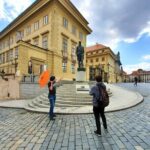
This is your quick hit of modern Prague at 5 minutes: the sculpture Kun by David Černý. Even in a short stop, it’s memorable because it’s visually bold and clearly of its own time. If you like Prague when it’s playful and not only historic, this is one of the best value moments.
Stop 10: Wenceslas Square
You’re back in the Wenceslas area with another 10-minute explanation segment. This repetition isn’t a mistake. It’s a way to let the guide zoom in on details and reinforce the horse-market idea while you’re in the right place to appreciate the surrounding architecture.
Stops 11 to 12: Sokolská 1595/62 and Na Rybníčku
These are brief stops (5 minutes each), designed for focused points of interest rather than long sightseeing. You can treat them as “tight interpretation” moments: listen, look around, then keep moving.
Charles Square to the river: Gothic and Baroque energy, then Vltava photos
As the tour continues, it leans into the highlights that make Prague feel like Prague. This is where you start seeing how major buildings and civic spaces connect to national culture, including references to the Czech national renaissance and the lead-up to Czechoslovak independence in 1918.
Stop 13: Charles Square
Charles Square is the cattle market centrality. When you hit this stop, you’ll understand why the tour keeps talking about planning: it’s not random. This is where the guide can connect the 14th-century urban structure to the later importance of this part of the city.
Stop 14: Resslova
Resslova keeps you in the “walk-through” mode. The point isn’t only photos; it’s to feel how Prague changes block by block and how architecture mixes styles over short distances.
Stop 15: Masarykovo nábřeží
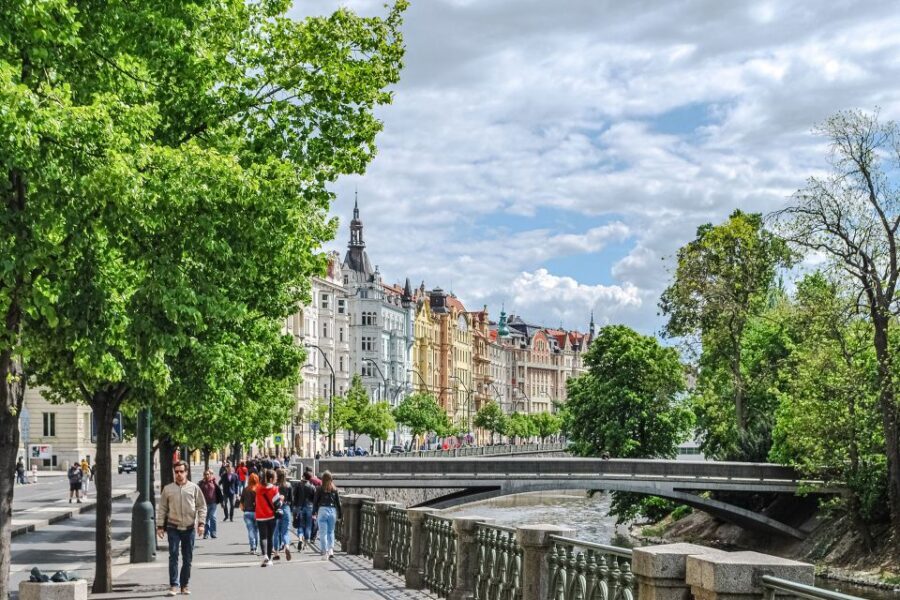
Now you’re shifting toward the river. This is a key moment because the tour’s highlights explicitly include a walk along the quays of the Vltava. Even if you’ve seen postcards of Prague before, standing alongside the river with context in your head changes how you look at the skyline.
Stop 16: Prague National Theatre
This is one of the major culture stops. The tour ties it to the Czech national renaissance and its role as a precursor of national identity before 1918. Even if you’re not a theater buff, the guide’s framing makes it easier to see why a building like this matters.
The Vltava and Archer’s Island photo segment
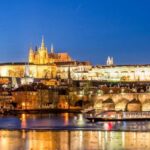
The tour includes time for unique photographs along the quays and on Archer’s Island. Expect your best photo angles to come when the river opens up and when the route places you between viewpoints rather than only beside monuments. Bring your phone or camera and be ready to pause without rushing, because the guide will point out what’s worth capturing.
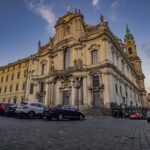
Along the way, the experience also references emblematic landmarks tied to the district’s architectural diversity, including the Powder Tower, the Estates Theater, the Municipal House, and the House of the Black Madonna. You may not get a full stop-by-stop history on each building, but you will get enough context to recognize why they’re famous and what they represent in Prague’s story.
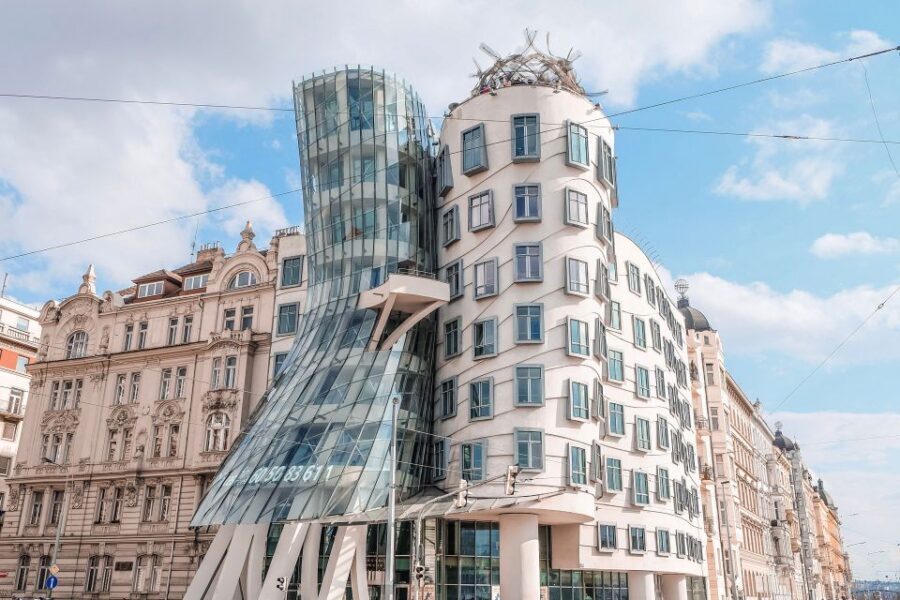
It also brings in more modern Prague moments, such as the Prague Spring, and the presence of contemporary architecture like the House Who Dances. That blend is part of the tour’s charm: it helps you see continuity, not just a list of eras.
Legion Bridge to Park Legií: finishing with views
The final stretch moves you into the best “end-of-tour” mood: a river crossing and a park finish.
Stop 17: Legion Bridge
This is a short stop (5 minutes) but it’s placed for a reason. Bridges change your sightlines, and in a walking tour, that’s where you often get your clearest “whole-city” feel. You’ll also be close to the part of the route that supports Archer’s Island views.
Stop 18: Park Legií
Park Legií is another 10-minute guided segment. This is where it makes sense to slow down and absorb. You’re finishing with open air, a calmer pace than the earlier squares, and a final set of explanations that wrap the district themes together.
How to plan your day around this walking tour
Even though this tour is only about 2.5 hours, plan for it to feel like a full city walk. Prague centers on foot, and the stops are spaced to keep attention fresh rather than packing you into one long talk.
Here’s how I’d plan it:
- Wear shoes you can walk in comfortably. You’ll be moving between multiple squares and streets, plus a river section.
- Bring a camera and accept that you’ll stop more than you expect, especially during the Vltava quays and Archer’s Island photo part.
- If you’re doing other attractions the same day, schedule the tour first or early. It gives you context for what you’ll see afterward.
Language-wise, it’s French only. If you read a bit of Czech or know a few French history words, great. If not, the guide still structures the walk so the main ideas land through place names and clear explanations.
And one note from what people loved most: the French narration is praised for being captivating. A name that comes up is Alexandre, known for interesting and engaging explanations, which is exactly what you want on a tour like this.
Who should book this Nové Město walk
This experience fits best if you:
- want Prague with explanations, not just sightseeing
- care about how a district’s urban plan shapes what you see today
- like mixing old architecture with modern culture references (Prague Spring, contemporary buildings, and the David Černý stop)
- prefer a structured walking pace with short guided moments instead of a long lecture
It’s also a good match for French speakers who want a guided route through key Nové Město areas without spending extra time figuring out how everything connects.
Should you book this tour or not?
I’d book it if you want a smart, compact way to understand Nové Město’s identity: Charles IV’s plan, the three market squares (hay at Senovážné, horses at Wenceslas, cattle at Charles Square), and the cultural weight of major institutions like the National Theatre.
I’d reconsider if you hate being outdoors during cold or wet weather, because the tour runs rain, shine or snow. Also, if you’re only chasing one single type of landmark (for example, only medieval churches or only museum interiors), this may feel more mixed than you want.
If you like architecture stories, Prague’s city layout, and river photos with context, this is a solid value at $27 for a licensed French guide and a full 2.5-hour walk.
FAQ
What language is the tour in?
The guided tour is in French.
How long is the walking tour of Nové Město?
It lasts about 2.5 hours.
How much does it cost?
The price listed is $27 per person.
Where do I meet the guide?
Meet in front of the entrance of Jindřišská Tower (Jindřišská věž).
What’s the easiest public transport to reach the meeting point?
Take the tram from Jindřišská station, served by lines 3, 5, 6, 9, 14, and 24.
Where does the tour end?
The itinerary indicates a finish at Park Legií. The activity info also says it ends back at the meeting point, so it’s worth confirming the exact end location when you book.
Is the tour indoors?
No. It takes place outdoors, rain, shine, or snow.
What’s included and what’s not included?
Included: a licensed local guide, a French walking tour and explanations, plus good addresses and advice. Not included: pick-up/return to your hotel, transport tickets, and food or drinks.