REVIEW · PRAGUE
Prague Old Town New Town and Jewish Quarter Morning Tour
Book on Viator →Operated by Explore Prague · Bookable on Viator
Few cities reward slow walking like Prague.
This 3-hour morning tour links the modern pulse of New Town with the drama of the Old Town and into the Jewish Quarter, so you come away with a working map of how the city grew. I like that it’s designed as a time-saver for first-timers, and I also like how often the guide points out the little details that make Prague feel strangely personal, not museum-like.
What I like most is the mix of big landmarks and quick side-stops. You’ll move through major squares and streets, plus smaller places like Franciscan Garden where the pace suddenly eases. And because the group tops out at 20, it usually feels more like a guided stroll than a cattle herd.
One consideration: this is a lot of walking over uneven old-town ground, and you’re outside for most of the tour. Wear shoes you’d actually trust for 15,000-ish steps, not your nicest sneakers, and plan for cold wind in winter or bright sun in summer.
In This Review
- Key highlights worth showing up for
- A 3-hour loop that strings Prague together
- Wenceslas Square to Lucerna Arcade: revolutions and a famous upside-down horse
- Franciscan Garden and Church of Our Lady of the Snows: a pause with a payoff
- Estates Theatre and Karolinum: where Mozart, Czech power, and learning meet
- The Municipal House, Powder Tower, and Prague’s stylistic weirdness
- Church hopping the right way: St. James to the walk into the Jewish Quarter
- Spanish Synagogue and the story of Kafka’s Prague link
- Old-New Synagogue and the cluster of neighboring synagogues
- Old Jewish Cemetery: one of central Europe’s surviving resting places
- Old Town Square and the Astronomical Clock show
- Guides make the difference: Petra, Jack (Honza), Mikal, Anna
- Price and value: what $32.65 buys you
- Who this tour suits best
- Should you book this tour?
- FAQ
- How long is the Prague Old Town, New Town, and Jewish Quarter morning tour?
- Where does the tour start and end?
- Is the tour offered in English?
- What is included in the price?
- Does the tour run in bad weather?
- How large are the groups?
Key highlights worth showing up for
- A fast orientation route that stitches together New Town, Old Town, and the Jewish Quarter without you getting lost
- Franciscan Garden + Our Lady of the Snows for a breather and a surprise Gothic church detail
- Synagogues with clear context so the Jewish Quarter stops don’t feel disconnected
- Art nouveau and theatre-era stories at the Municipal House and Estates Theatre
- Plenty of photo points across towers, arcades, courtyards, and major squares
- A guide matters and the tour has a strong track record with guides like Petra, Jack (Honza), Mikal, and Anna
A 3-hour loop that strings Prague together
The big win with this tour is the way it builds momentum. You start near Wenceslas Square in New Town, then work your way through Old Town’s classic sights, and finally shift into the Jewish Quarter before ending at Old Town Square in front of the Astronomical Clock.
That matters because Prague can feel like separate storybooks when you explore on your own. This route gives you the “how it connects” thread: squares lead to streets, streets lead to institutions (theatres, universities, churches), and those lead naturally to the Jewish Quarter and its surviving landmarks.
Also, the tour is about 3 hours, which is a sweet spot. Long enough to feel like you learned something real, short enough that you can still do your own wandering afterward.
A few more Prague tours and experiences worth a look

Wenceslas Square to Lucerna Arcade: revolutions and a famous upside-down horse
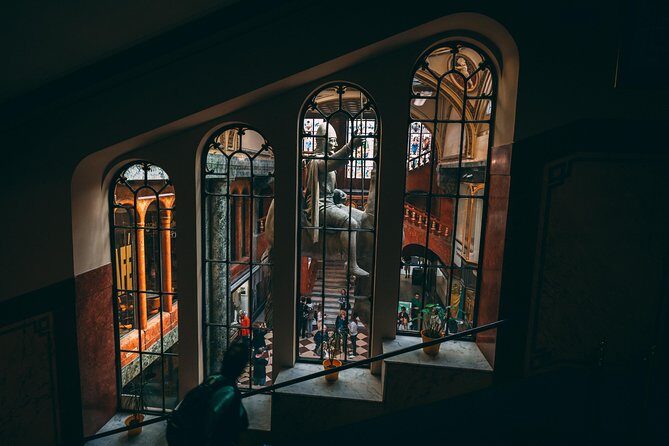
You kick off at the top of Wenceslas Square, a place that has played a role in major revolutions and military parades across the 20th century. Even if you don’t know Czech history yet, this start gives you a mindset: Prague isn’t only pretty architecture, it’s a city with real political weather.
From there you head toward Lucerna Arcade and the Lucerna Palace area linked to the Havel family. One reason this stop pops is the David Černý statue of an upside-down horse. It’s the kind of modern, slightly cheeky artistic disruption that makes sense in Prague once you’ve seen a few layers of the city.
Practical note: these first stops are in open streets and sidewalks. If it’s windy or cold, you’ll feel it right away. Your best move is to pack warm layers early, not halfway through the tour.
Franciscan Garden and Church of Our Lady of the Snows: a pause with a payoff
Next comes Franciscan Garden, and it’s exactly what you want between big monuments: a small pocket of calm. This is one of those places that helps you reset your head for the history you’re about to absorb. You’ll also get a contrast moment, because Prague photos often flatten the city into one style. Here you feel the temperature drop and the crowd thin.
Right beside the garden is the Church of Our Lady of the Snows, a Gothic church with an unexpected story: it was supposed to become the greatest church in Prague but it was never finished. The interior is where the stop really pays off, including the tallest altar in Prague. That detail alone gives you a concrete reason to look up and slow down once you’re inside.
Why this stop works for first-timers: it teaches you that Prague’s “unfinished” plans are part of the story. Not every building survived intact, and not every dream got completed. It’s a very human way to see architecture.
Estates Theatre and Karolinum: where Mozart, Czech power, and learning meet
After the quieter garden time, you’ll step into Estates Theatre (the Theatre Des États). This is the oldest theatre in Prague city centre, and it has a direct link to W.A. Mozart performing in Prague. The tour also explains local opposition to the theatre’s construction, which gives you a reminder that even culture upgrades had critics.
Then you’re close to Karolinum, tied to Charles University, where the tour connects the dots to Charles IV and why he matters in Czech history. This is one of those “institutions” stops that feels abstract until you hear how the place fits into the city’s power structure.
If you’re the type who loves politics as much as architecture, these two stops work well back to back. Theatre and a university might sound unrelated, but in Prague they’re both expressions of influence.
The Municipal House, Powder Tower, and Prague’s stylistic weirdness
As you walk, the tour leans into a fun Prague trait: style changes faster than your expectations. You’ll see Prasna brana (the Powder Tower), once a representative entrance into the Old Town and later used as storage. It has a strange history, and the guide’s job is to make that shift feel logical instead of random.
Nearby is the Municipal House (Obecni Dum), described as a pearl of art nouveau. This stop gives you context for why the building was built and how it’s used today. Even if you’re not an art nouveau expert, you’ll notice the city has a taste for ornament, symbolism, and flourishes in the middle of daily life.
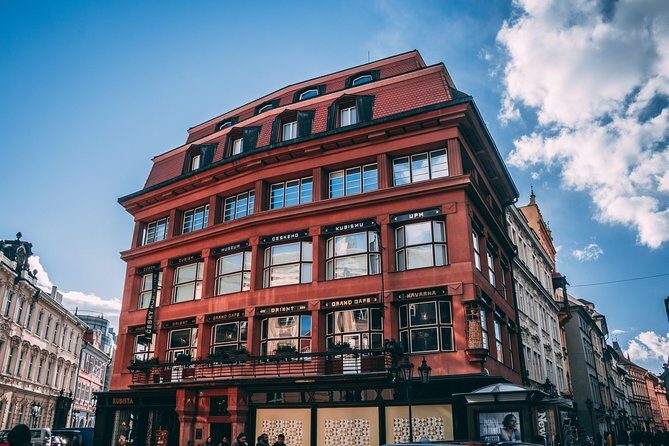
Then you head to the House of the Black Madonna, which is a great checkpoint for anyone trying to understand what people mean by a distinctly Czech architectural style. It’s not just a decorative curiosity; it helps you see how Prague has identity markers you won’t find in every European capital.

Church hopping the right way: St. James to the walk into the Jewish Quarter
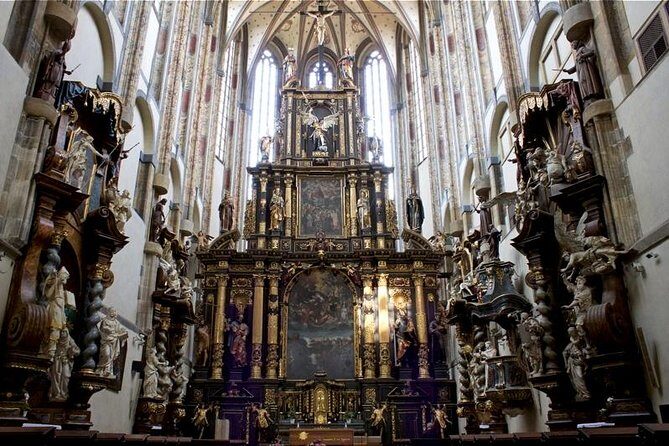
By the time you reach the Church of St. James, you’ve already seen enough that this one lands differently. It’s the biggest and most beautiful Baroque church of the Old Town, and it’s worth it because the tour frames it as more than a quick exterior glance. You’ll have time to admire the interior, which is where baroque tends to go from “pretty” to “wow.”
After that, you move into the Jewish Quarter. You’ll be walking with a guide who explains why Prague had such a large Jewish ghetto and how that story runs from medieval times toward today. That kind of narrative matters because the synagogues and cemeteries can otherwise feel like isolated stops rather than parts of a continuous community experience.
One positive detail: the tour is paced so you’re not sprinting. If your feet start to protest, you’ll still get enough context to make the next stop feel worth it.
Spanish Synagogue and the story of Kafka’s Prague link
Your first Jewish Quarter stop is the Spanish Synagogue. Beside it is a statue of Franz Kafka, and the tour uses that connection to ground you in Prague’s broader cultural output, not only its religious architecture.
Even when you’re not into religious history, synagogue architecture can look like a different world from the churches you’ve been seeing. The guide’s explanation helps you recognize that the details weren’t random. They point toward a community life, traditions, and a place that had to keep existing even under pressure.
Admission here isn’t included, so it’s worth knowing you may want to decide on the spot whether to pay for entry. The tour still provides value without the ticket, but if you want full access, plan for it.
Old-New Synagogue and the cluster of neighboring synagogues
Next up is the Old-New Synagogue, described as Prague’s oldest synagogue. The tour doesn’t treat it as a standalone relic. Instead, you get the story of neighboring synagogues too, including the High Synagogue, Klausen Synagogue, and Ceremonial Hall.
This stop is especially good for history buffs and architecture lovers because it helps you see the Jewish Quarter as a network rather than a single building. You’ll also get a sense of continuity: old structures living alongside newer uses, and a city that keeps layering time on top of time.
Again, admission isn’t included, so your guide’s rundown becomes your “pre-entry” view if you choose not to buy a ticket in that moment.
Old Jewish Cemetery: one of central Europe’s surviving resting places
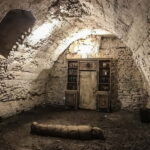
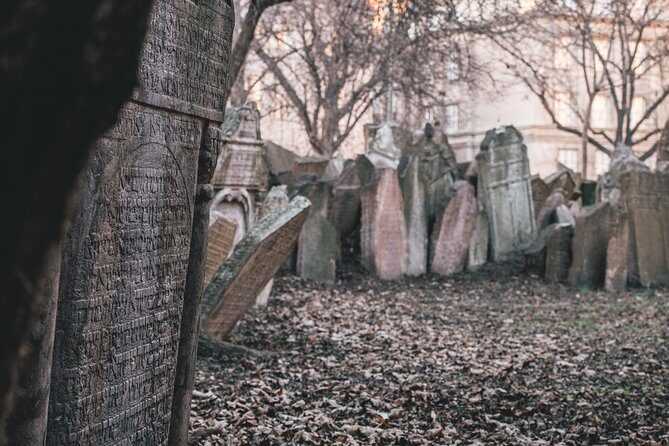
Then you reach the Old Jewish Cemetery, described as one of the most enchanting cemeteries in central Europe. The tour explains why it’s so extensive and why it survived WWII, which is not a detail you want to skip.
This is the part where the tour often feels most reflective. You might notice how the guide’s tone changes—less quick-fire storytelling, more careful framing—so you can actually take it in.
Admission isn’t included here either, so be ready to make a choice based on your interests and budget. If cemeteries aren’t your thing, the context the guide gives still helps you understand why this place matters.
Old Town Square and the Astronomical Clock show
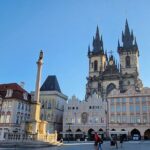
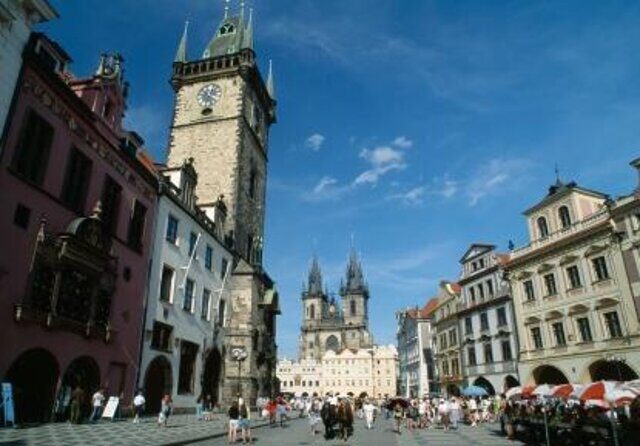
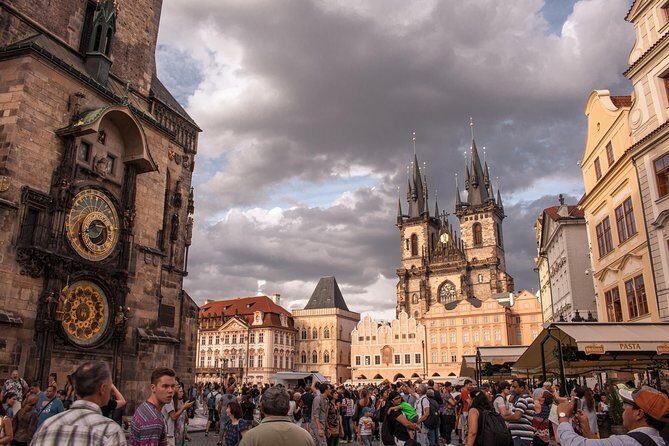
The tour ends where most people want to be on their first Prague day: Staroměstské náměstí (Old Town Square). Here you’ll hear stories about major sights, including St. Nicholas, Týn Church, the statue of Jan Hus, and the Column of St. Mary. It’s a visual mix of styles, and the tour helps you decode the differences rather than letting your eyes bounce off details.
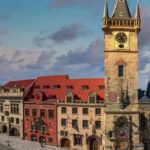
The final stop is Old Town Hall with the Astronomical Clock. You’ll learn when it was built and how the complex clock works, then watch the hourly show. This is a classic tourist moment, but the tour makes it more than a quick photo because you understand what you’re looking at before it starts.
If you time your arrival well, you can also plan your next steps right after the tour. The guide is set up to offer suggestions for what to do next in Prague.
Guides make the difference: Petra, Jack (Honza), Mikal, Anna
A standout feature from the tour’s track record is how strongly the guide experience comes through. Names you might recognize include Petra, Jack (Honza), Mikal, and Anna—and the common thread is pacing and clarity.
In plain terms, good guides do three things:
- They keep the tour moving without rushing the important parts.
- They answer questions in a way that doesn’t derail the group.
- They adjust energy for the weather, like keeping a warm-up pause in mind during cold mornings.
If you happen to get a guide who’s good at story structure, the Jewish Quarter and the architecture stops feel connected instead of like a checklist.
Price and value: what $32.65 buys you
At about $32.65 per person for roughly 3 hours, you’re paying mainly for a licensed guide plus the “route intelligence” that saves you time. You’re also getting a mobile ticket and an organized flow from New Town into the Old Town core.
Where value gets tricky is admissions. Some stops list admission tickets as free, while others say admission isn’t included. That means your actual out-of-pocket spend can rise if you decide to enter the theatres, synagogues, university-related spaces, or the cemetery.
Still, even without buying every ticket, a good guide can make your exterior time useful. You come away with context you’d struggle to piece together on your own in the same tight timeframe.
Also, the tour is booked about 29 days in advance on average, which usually signals it’s popular for a reason. If you want a particular date in peak season, don’t wait too long.
Who this tour suits best
This tour is a strong match if you:
- want a first-time orientation that doesn’t feel shallow
- care about architecture, but also enjoy the stories behind it
- like walking enough to see a lot in one morning
- want a structured path that still leaves you time to explore after
It’s not the best choice if you hate crowds, can’t do uneven pavement, or prefer to spend your morning fully inside museums and churches with minimal walking.
Should you book this tour?
I’d book it if you want Prague’s main neighborhoods stitched together into one clear storyline. It’s built for momentum: squares, churches, a theatre, a university connection, art nouveau and odd Prague landmarks, then the Jewish Quarter, ending at Old Town Square for the Astronomical Clock show.
If you’re the type who needs every stop to be inside a building, you might want to plan extra ticket spending for the non-free admissions. But if you like understanding what you’re seeing before you see it, this morning route is a smart use of time.
FAQ
How long is the Prague Old Town, New Town, and Jewish Quarter morning tour?
It runs for about 3 hours.
Where does the tour start and end?
The tour starts at the Statue of Saint Wenceslas at Václavské náměstí, Prague 1-Nové Město, and it ends at Old Town Square in front of the Astronomical Clock.
Is the tour offered in English?
Yes, it’s offered in English.
What is included in the price?
You get a professional licensed guide and a mobile ticket. Admission tickets are listed per stop and may be free for some sights while others are not included.
Does the tour run in bad weather?
Yes, it operates in all weather conditions, so dress appropriately.
How large are the groups?
The tour has a maximum of 20 travelers.