REVIEW · PRAGUE
Prague Old Town: Private Tour
Book on Viator →Operated by Free Walking Tour Prague · Bookable on Viator
Prague’s Old Town teaches you to look closer. This private walking tour strings together surprising stops, from the first Cubist building in Prague to the Astronomical Clock and the Jewish Quarter, with an English guide who keeps the story moving. You also get a real schedule perk: multiple departure times, so you can fit Old Town into your day without stress.
I really like the shape of the route. You’ll hit the big architectural and historical anchors, but you’ll also get the side stories that make the streets feel alive. I also love the private-group pace, where you can ask questions and move at a comfortable rhythm with a friendly English-speaking guide.
One thing to plan for: it’s still a walking tour of about 2.5 hours. If you’re not used to walking cities, wear comfy shoes and keep water in mind, because there’s no food or drinks included.
In This Review
- Key highlights at a glance
- Why this Prague Old Town tour feels better than DIY
- Powder Tower start and Charles Bridge finish: easy flow for your day
- The first Cubist building in Prague: art that interrupts the postcard
- The oldest theatre in Prague and Mozart’s famous connection
- Charles IV and the oldest university in Central Europe (founded 1348)
- Týń Church, Jan Hus statue, and Saint Nicholas Church: the moral map of Old Town
- The building story and the Astronomical Clock: why it’s more than a show
- Jewish Quarter highlights in one walk: synagogues, halls, and the old cemetery
- Guides that make the stories click: Iva, Tereza, Via, and Tony
- Price and what you truly get for $54.42 per person
- Logistics that make the tour easier: mobile ticket, flexible timing, transit access
- Who this Prague Old Town private tour is best for
- Should you book this tour?
- FAQ
- How long is the Prague Old Town private tour?
- Is this a private tour?
- What language is the tour offered in?
- Where does the tour start and end?
- What is included in the price?
- Are food and drinks included?
- Do I receive a mobile ticket?
- What kind of walking is involved?
- Can I cancel for a full refund?
Key highlights at a glance
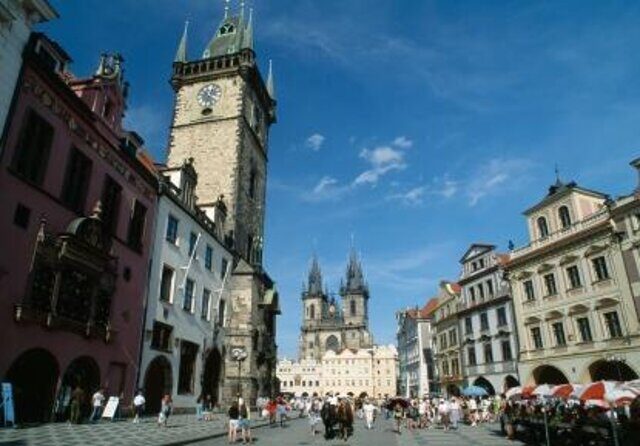
- A compact 2.5-hour route that covers Cubism, Mozart’s famous oldest theatre connection, Charles IV’s legacy, the Astronomical Clock, and the Jewish Quarter
- Private-group touring so your guide can tailor the pace and handle questions without a crowd crush
- Landmark-to-story storytelling, with guides like Iva, Tereza, Via, and Tony praised for being fun, upbeat, and focused on connections between old events and later life
- A smart Old Town finish right near the Charles Bridge area, so it’s easy to keep exploring afterward
- Jewish Quarter depth in one sweep, including synagogues, the Jewish Town Hall, the Jewish Ceremonial Hall, and the Old Jewish Cemetery
Why this Prague Old Town tour feels better than DIY
Old Town Prague can be visually loud. The buildings are gorgeous, but if you wander alone, it’s easy to miss why things are there and how they connect. This tour gives you a guided path through the same streets, with a guide who turns landmarks into cause-and-effect stories.
Because it’s private, you get something you usually don’t get in a busy city center: breathing room. You’re not trying to keep up with a pack while the guide darts ahead to “the next photo spot.” Instead, you can slow down when something catches your eye.
The second big win is how the tour mixes styles and eras without turning into a textbook. You’ll go from a Cubist building to a theatre linked to Mozart, then to the oldest university in Central Europe founded in 1348 by Charles IV. That variety matters. It keeps your brain engaged, and it helps you build a map of Prague that actually sticks.
You can also read our reviews of more private tours in Prague



Powder Tower start and Charles Bridge finish: easy flow for your day
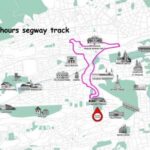
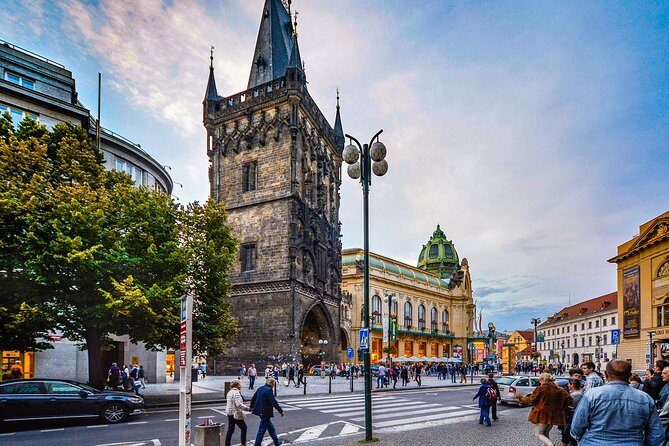
The tour starts at Powder Tower (Nám. Republiky 5, Staré Město). That’s a practical choice because it puts you right where you can orient yourself quickly, and it’s simple to reach using public transportation.
The tour usually ends by Charles Bridge (Karlův most). For many visitors, that’s the ideal payoff. You’ve just learned your way through Old Town’s key landmarks, and you finish at one of the most iconic “walking lanes” in the city. From there, you can keep going, grab a coffee, or cross into the next part of your itinerary without needing to backtrack.
A small but real advantage: the route is designed around a logical walk from one major cluster to another. You’re not crisscrossing streets just to see the next thing.
The first Cubist building in Prague: art that interrupts the postcard
One of the most interesting stops is the first Cubist building in Prague. Prague is often associated with gothic spires, baroque curves, and medieval stone. So when Cubism shows up, it feels like the city is nudging you to pay attention to different kinds of creativity.
This is one of those moments where a guide adds value fast. Even if you know the basics of Cubism from museums, you’ll still want context: why this style appeared, what it meant in Prague’s world, and how to “read” the building’s shapes when you’re standing right in front of it.
The takeaway for your own exploring: you’ll start noticing details on your way between stops. You’ll look at angles and structure differently, not just at the overall skyline.
The oldest theatre in Prague and Mozart’s famous connection
Another stop centers on the oldest theatre in Prague, known for its connection to Mozart. This is a great example of why guided tours work: the building itself is impressive, but the real interest is what it represents—how Prague’s cultural life moved through time.
When you hear the story tied to Mozart, you get a time anchor. You stop treating the theatre as just a pretty exterior and start seeing it as part of a cultural network: performances, patrons, and the city’s identity as a place where music mattered.
Practical note: theatres can make people want to linger. If you’re the kind of traveler who likes to pause for a close look, this stop is likely to reward you. If you’re more photo-focused, it still works because the route keeps you moving while giving you enough context to understand what you’re seeing.
Charles IV and the oldest university in Central Europe (founded 1348)
Next up is the oldest university in Central Europe, founded in 1348 by Charles IV. This is one of those facts that sounds dry until a guide frames it as a turning point.
Universities are more than lecture halls. They’re where ideas circulate, where politics gets argued in slow motion, and where the future leadership class gets formed. When the guide ties the university’s founding to Charles IV, you start to see why that era matters for Prague’s long timeline.
This stop also helps you understand the city’s architecture as more than decoration. Education changes what gets built, what gets funded, and who gets to influence the city’s direction.
It’s a smart place to be curious. If you ask questions here, your guide can connect the dots between governance, culture, and the streets you’re walking.




Týń Church, Jan Hus statue, and Saint Nicholas Church: the moral map of Old Town
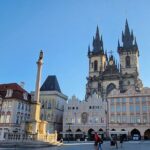
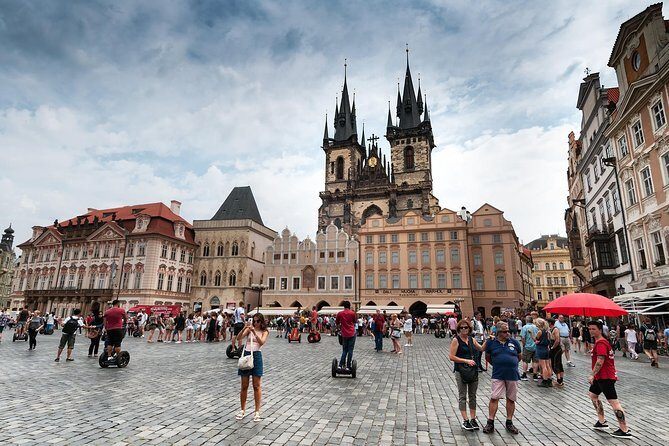
The tour then moves through a cluster that includes Týń Church, the Statue of Jan Hus, Saint Nicholas Church, and more. This part is where Prague’s identity comes through in a very human way.
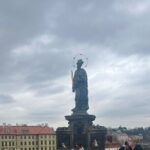
Jan Hus is not a small footnote. He represents a clash of ideas that shaped the religious and political atmosphere of the region. Standing near his statue, you can connect the story to the bigger questions: who had authority, who challenged it, and how Prague navigated change.
Týń Church and Saint Nicholas Church add another layer. These aren’t just pretty stops; they show how different styles and beliefs lived side by side over centuries. A guide’s job here is to keep it understandable. You’ll want someone to explain what you’re seeing and why it matters, without drowning you in dates.
One thing I like about this section is that it breaks up the “clock and corners” feeling. It gives you a more reflective pause in the walking rhythm, which helps when you’re heading into the more technical stop later: the Astronomical Clock.
The building story and the Astronomical Clock: why it’s more than a show
The Astronomical Clock of Prague is famous, but fame can be a trap. Without context, it can feel like you’re just watching something impressive instead of understanding what it’s telling you.
This tour gives you the history of the building around the clock first, then brings you to the clock itself. That order matters. When you learn what the clock tower and its setting represent, the details stop being random.
Expect to walk away with a better grasp of why the clock mattered to people at the time. It wasn’t only for wow-factor. It was a way to track the world, map time, and signal knowledge in public space.
If you like learning by seeing—this is your kind of stop. You’ll look longer than you planned to, because the guide’s explanation gives you something to watch for.
Jewish Quarter highlights in one walk: synagogues, halls, and the old cemetery
The Jewish Quarter portion is one of the most meaningful parts of the tour. You’ll visit synagogues, the Jewish Town Hall, the Jewish Ceremonial Hall, and the Old Jewish Cemetery.
What makes this section work well in a walking format is pacing and focus. You’re not trying to cram random spots into a tight schedule. Instead, you’re taken through a set of locations that help you understand how community life worked—religion, administration, ceremonial practice, and memory in one connected space.
This is also where a private guide adds weight. A good guide can explain the names of buildings and roles in ways that help you stay oriented. If you’re traveling as a family, this is often the section where kids (and adults) start asking better questions, because it’s easier to connect what you see to why it mattered.
If you care about respectful travel, this part is particularly good. It’s not just sightseeing. It encourages you to slow down and read the significance behind the architecture.
Guides that make the stories click: Iva, Tereza, Via, and Tony
The single biggest reason this tour gets such consistent 5/5 praise is the guiding style. People specifically mention guides such as Iva, Tereza, Via, and Tony for being engaging and fun while still packing in clear context.
Several themes show up in the way these guides are described:
- upbeat energy that keeps the walk light
- a strong ability to explain lots of history in a way that stays understandable
- time taken to answer questions without rushing you off to the next corner
- flexibility, so the tour feels like it fits your pace rather than the other way around
One guide example that stands out is Via, described as focusing on political history of Prague and Old Town. That’s a great option if you like understanding how power, events, and ideas shaped the city you’re walking through.
For me, that matters because Prague can overwhelm you. When your guide helps you connect what happened then to what you see now, you come away feeling like you learned something real, not just collected photos.
Price and what you truly get for $54.42 per person
At $54.42 per person for about 2 hours 30 minutes, the value depends on how you like to travel.
If you’re the type who enjoys architecture but also wants interpretation, this price can feel fair because you’re paying for a live story—someone standing next to you, steering you through the key places, and translating the meaning of what you see. For a city like Prague, that can be the difference between wandering for hours and getting a clean, memorable framework.
The “private” part also helps. Instead of spreading attention across a large group, you’re sharing it with your own group only. That’s not just comfort—it often means you can ask questions that would get ignored in a crowd.
Food and drinks are not included (unless specified), so budget for a stop later. That’s normal for a walking tour, but it’s worth planning so you don’t feel stuck trying to find something quick while you’re tired.
Logistics that make the tour easier: mobile ticket, flexible timing, transit access
This tour uses a mobile ticket, which is convenient when you’re juggling photos, maps, and transit. The tour is also offered in English, so you won’t have that common Prague issue of language gaps at the exact time you want the most context.
It’s near public transportation, and that helps if your day includes hopping between neighborhoods. Also, the tour has a choice of departure times, which is a practical win in Old Town, where schedules can get tight.
Physical fitness level is listed as moderate. You should be able to handle a sustained walk with some stops, and you’ll want comfortable shoes. If you’re recovering from an injury or you need frequent breaks, you might want to think twice or ask about a slower pacing approach when booking.
Who this Prague Old Town private tour is best for
This is a smart choice if you want:
- a guided route through major Old Town highlights without wasting time
- a mix of architecture, culture, and the “why” behind the sights
- a private-group experience where you can ask questions and slow down
It’s especially good for first-timers who want orientation fast. Prague is easy to photograph and easy to get lost in. This tour gives you a workable mental map: Cubism, Mozart-era culture, Charles IV’s influence, the Astronomical Clock, and the Jewish Quarter.
It also works well for people who like history but don’t want a lecture that forgets the street you’re standing on. The stop order moves from visual curiosity to historical context without getting stuck in one theme.
Should you book this tour?
I’d book it if you want Old Town Prague with structure and meaning. The combination of major landmarks (like the Astronomical Clock), major eras (like Charles IV and the university founded in 1348), and the Jewish Quarter in one smooth walk makes this a strong value for your time.
Skip it—or at least think carefully—if you only want casual sightseeing with no interest in explanations. This tour is built to be interpretive. Also remember it’s about 2.5 hours of walking.
If you can handle a moderate walking pace and you want an English guide to help you “read” Prague, this private tour is one of the best ways to turn a pretty city into a city you actually understand.
FAQ
How long is the Prague Old Town private tour?
The tour is approximately 2 hours 30 minutes.
Is this a private tour?
Yes. It’s a private tour/activity, and only your group will participate.
What language is the tour offered in?
The tour is offered in English.
Where does the tour start and end?
The tour starts at Powder Tower (Nám. Republiky 5, Staré Město, 110 00 Praha 1). It usually ends by Charles Bridge (Karlův most, 110 00 Praha 1).
What is included in the price?
It includes a friendly English-speaking guide.
Are food and drinks included?
Food and drinks are not included, unless specified.
Do I receive a mobile ticket?
Yes, it includes a mobile ticket.
What kind of walking is involved?
It’s a walking tour, and the physical fitness level is listed as moderate.
Can I cancel for a full refund?
You can cancel for free up to 24 hours in advance for a full refund. If you cancel less than 24 hours before the start time, the amount paid is not refunded.