REVIEW · PRAGUE
Prague Synagogues and Jewish Quarter Private Walking Tour
Book on Viator →Operated by Private Prague Guide Day Tours · Bookable on Viator
Josefov is small, but the stories hit hard. This private Prague Jewish Quarter tour strings together synagogues and a cemetery with real context—how the community lived, survived, and memorialized its losses.
I especially like two things: you get a live guide who can answer questions as you go, and the route is built around major sites in one focused loop, from the Old Jewish Cemetery to the Old-New Synagogue (where Kafka attended services). One possible drawback: it’s a slow, stop-and-talk style walk, so if you want more walking and less pausing, you’ll want to set expectations with your guide.
In This Review
- Key things to know before you go
- First Meeting Under the Astronomical Clock: Getting Oriented Fast
- Josefov and the Jewish Museum Focus: Why This Quarter Survived
- Maisel Synagogue (Built 1592): Philanthropy in Stone
- Pinkas Synagogue (1535): A Holocaust Memorial You Can See
- Old Jewish Cemetery: Layered Graves and the Golem Legend
- Klausen Synagogue (Built 1694): Baroque Style With a Story of Learning
- Old-New Synagogue: The Oldest, Still Active (and Kafka’s Link)
- Spanish Synagogue (1868): Moorish Interior and a Reform Congregation
- Timing, Walking Pace, and What 2.5 Hours Feels Like
- Price ($175.24): What You’re Paying For, and How to Judge Value
- Who This Tour Suits Best (and Who Might Want Another Option)
- A Quick Booking Reality Check
- Should You Book the Prague Synagogues and Jewish Quarter Private Walking Tour?
- FAQ
- How long is the Prague Synagogues and Jewish Quarter private walking tour?
- Is the tour in English?
- Do I get hotel pickup?
- Where does the tour start?
- Are tickets included for the Jewish Museum sites?
- Which synagogues and cemetery stops are included?
- Is this a private tour or a group tour?
- Is a mobile ticket provided?
- What is the price per person?
- Can I cancel for free?
Key things to know before you go
- A private 2.5-hour route through Josefov, designed for questions, not a speed-run
- Hotel reception pickup on foot (no car pickup), if you’re staying in the city center
- Multiple major synagogues plus the Old-New and Klausen—each with a different reason to matter
- Old Jewish Cemetery details including layered graves and the Rabbi Loew/golem legends
- English-language guidance with a guide who manages timing around closures
- Jewish Museum access included, but individual stop notes vary—confirm what’s covered for your date
First Meeting Under the Astronomical Clock: Getting Oriented Fast
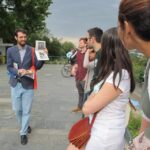
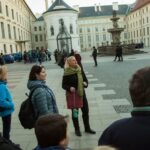
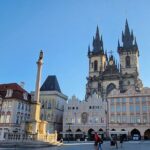
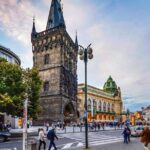
The tour starts right where most people naturally gravitate in Prague: near the Astronomical Clock in the Old Town area. Meet your guide under the Clock, then you head straight into Josefov. It’s a smart move because you don’t waste time guessing where the Jewish Quarter begins.
That first transition matters. When you walk into Josefov with a guide setting the timeline, the buildings stop feeling like random stops and start feeling like chapters. You also get an easy warm-up stop tied to one of Prague’s biggest landmarks, with no extra admission noted for that initial segment.
Practical note: this is pickup on foot, not by car. So if you’re outside the center or on a hilltop address, you might be asked to meet a bit closer in. Share your exact location early.
You can also read our reviews of more walking tours in Prague



Josefov and the Jewish Museum Focus: Why This Quarter Survived
One of the biggest reasons Josefov draws people from all over isn’t only the architecture. It’s the fact that the area was not destroyed during World War II, which makes the preserved setting feel more immediate than a museum display alone.
From there, the tour centers on the Jewish Museum complex—presented as a single theme you can carry through multiple sites: traditions, art, history, and the physical space where these stories were recorded in buildings and objects.
What you’ll like here is the “why” behind the buildings. The guide doesn’t treat synagogues as pretty boxes. Instead, you learn how the community’s needs—worship, education, charity, memorial—shaped what got built and what got preserved.
Maisel Synagogue (Built 1592): Philanthropy in Stone
Maisel Synagogue is the first deep architectural and social lesson of the day. Built in 1592, it’s tied directly to Mordecai Maisel, a philanthropist who served as mayor of the Jewish town and backed a lot of community infrastructure.
The details you hear here are the point: donations for a public bathhouse, ritual baths, and an almshouse; support for Jewish organizations; and funding for key civic and religious buildings. In other words, this synagogue isn’t just a place to pray—it’s evidence of a community building tools for daily life and dignity.
The only thing to watch is time. This stop is not meant to drag. It’s one of those “get the story, see the space, move on” segments—so if you want extra photos or quiet looking, plan to ask your guide for a couple minutes before you reach the next doors.
Pinkas Synagogue (1535): A Holocaust Memorial You Can See
Pinkas Synagogue is heavier. Built in 1535, it’s part of the Jewish Museum and functions as a memorial to nearly 80,000 Jewish victims of the Holocaust from the Czech lands.
This is one of the stops where your guide’s tone and pacing matter. You’ll want to slow down internally, because the memorial purpose changes how you read the room. Instead of “look at the synagogue,” it becomes “stand where remembrance is the main function.”
If you’re sensitive to memorial spaces, this is the one to flag mentally. The rest of the tour includes legends and cemetery stories, but Pinkas is the direct documented memorial stop.
Old Jewish Cemetery: Layered Graves and the Golem Legend
The Old Jewish Cemetery is one of the most striking stops in Europe for a reason you can’t miss once you’re there: it’s huge, old, and it shows how survival and population pressure collided.
You’ll hear that it served as one of the largest Jewish burial grounds in Europe and that it operated from the 15th century to the late 18th century. Approximately 80,000 residents of the Prague ghetto were buried there. When space ran out, tombs were layered on top of each other—one section reaches 12 layers.
That layering is a concrete way to understand history. It turns “overcrowding” into something physical you can stand next to. It also helps you see why Jewish cemeteries can look visually different from other European burial grounds.
Then there’s the story most people come for: Rabbi Judah Loew ben Bezalel is linked with the legend of creating a golem—described here as a mud figure said to be summoned to protect the community against anti-Semitic attacks. Whether you see it as folklore or cultural memory, it gives the cemetery a second layer of meaning: fear, protection, and how people tried to interpret the dangers around them.
You can also read our reviews of more private tours in Prague


Klausen Synagogue (Built 1694): Baroque Style With a Story of Learning
Klausen Synagogue is presented as the biggest synagogue in Prague’s Jewish Town. The word Klausen originally referred to three smaller buildings from the 16th century on the same site, including a yeshivah (Talmudic school) founded by Rabbi Loew.
After a ghetto fire in 1689, Klausen was erected in 1694 in early Baroque style. That timeline is useful because it gives you a cause-and-effect story: disaster happens, community reorganizes, and the architecture follows.
This stop works well if you like the “education and community” side of the Jewish story, not only the religious building side. Your guide can tie it to the broader theme: synagogues weren’t isolated. They fit into a system—teaching, worship, and communal support.
Old-New Synagogue: The Oldest, Still Active (and Kafka’s Link)
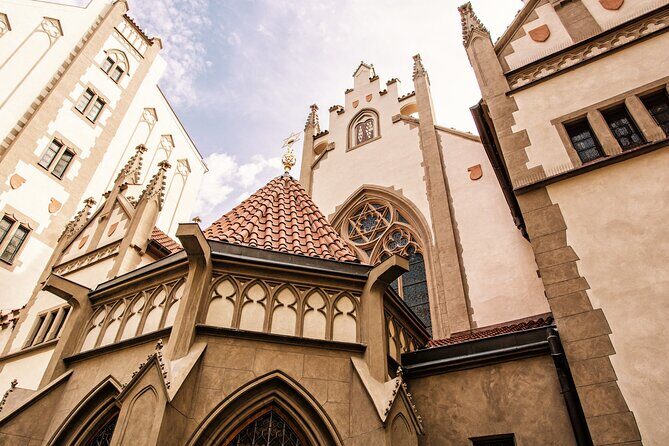
The Old-New Synagogue is a standout for being both ancient and still in use. Built in Gothic Cistercian style during the late 13th century, it’s described as the oldest building in the Jewish Town and one of the oldest synagogues in Europe that remains active.
You’ll also hear the long timeline of relevance: it served as the main synagogue of the Prague Jewish community for more than 700 years.
And then there’s the Franz Kafka connection—he attended services here. Even if you’re not a Kafka superfan, that detail helps you feel how Prague’s writers and intellectual life overlapped with this space.
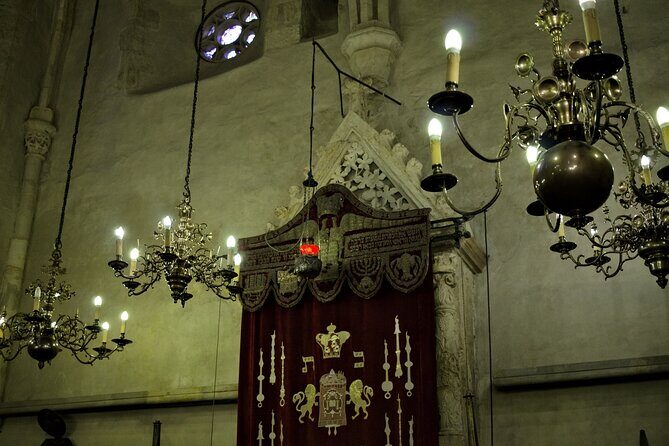
Legend-wise, you’ll hear that the golem is hidden in the attic. The thing to remember is how legends survive alongside real buildings. Even when you strip away “true or not,” the story shows what people wanted from their myths: protection, resilience, and hope.
Spanish Synagogue (1868): Moorish Interior and a Reform Congregation
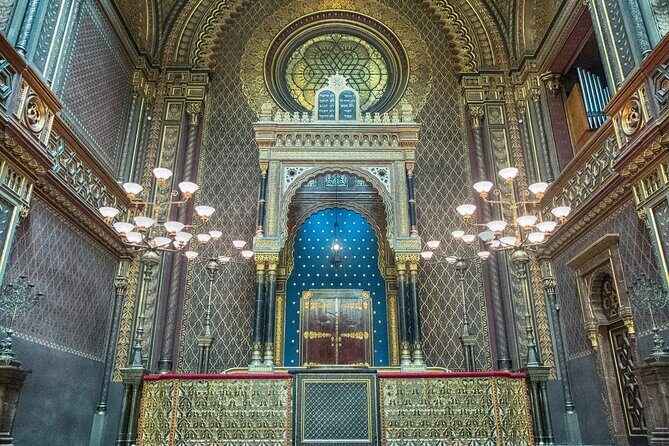
The Spanish Synagogue is where the architectural language shifts. Built in 1868 for the local Reform congregation, it sits on the site of an earlier 12th-century synagogue called Altschul.
Why “Spanish”? The interior is described as Moorish, with design influences compared to the famous Alhambra. It’s a great stop if you like seeing how Jewish worship spaces changed style as the centuries moved on.
This isn’t presented as a “final wow” moment—it’s more like a reminder: Jewish Prague wasn’t frozen in time. It adapted.
Timing, Walking Pace, and What 2.5 Hours Feels Like
The tour is listed at about 2 hours 30 minutes, and the schedule is built with the idea that you’ll have time to learn and ask questions. That matches what I’d expect from a private setup: the guide can keep the flow without hurrying you through doors like a checklist.
But there’s also a practical reality: synagogue visits and museum spaces slow you down. One pace note to take seriously is that the experience can feel like a lot of stop-and-talk. If you’re the type who likes walking while hearing stories at the same time, this may feel more like you pause, listen, then move again.
A good way to handle that: when you meet your guide, tell them what you prefer—more time looking, more time moving, or extra questions at certain stops. A good guide will calibrate. The tour’s strongest reviews also point to guides managing timing so you see what you came for before places close.
In terms of location feel, expect you’ll cover a walk through Josefov, mostly on foot within the old city fabric. It’s not the kind of tour where you bounce quickly between far-off districts.
Price ($175.24): What You’re Paying For, and How to Judge Value
At $175.24 per person for roughly 2.5 hours, this isn’t a budget stroll. But it can be good value if you care about more than seeing front doors.
Here’s what the price buys:
- A private guided experience (not mixed-group pacing)
- A licensed guide who’s meant to be fun and local
- Jewish Museum tickets included as part of the package
- Pickup offered at your hotel reception or another city-center location (but only on foot)
- A stated charity component supporting local children’s homes on a regular basis
So what’s the tradeoff? If you’re the type who can read plaques and guide yourself through rooms, you might feel the cost more sharply. Also, admission notes for individual synagogues show up as mixed. The package says Jewish Museum tickets are included, but some stop notes say ticket admission isn’t included. Before you go, it’s smart to confirm which sites your ticket covers for your date so you don’t get surprised at any door.
For value, I’d think about this way: this is you paying for someone to stitch together architecture, community life, and memorial meaning into one coherent story while you stand in the actual rooms.
Who This Tour Suits Best (and Who Might Want Another Option)
This tour is especially a good fit if you:
- Want a private walk through Prague’s Jewish Quarter, not a crowded group
- Like synagogue interiors and cemetery details, not only exterior photos
- Care about how the Jewish community evolved over time in Prague, including the Holocaust memorial elements
It may be less ideal if you:
- Want a brisk walking pace with little stopping
- Prefer mostly outdoor sightseeing with minimal indoor memorial time
- Are very price-sensitive and plan to self-tour with guidebooks
One more tip: the English-language option is a plus, and multiple guide names show up in positive comments—Gabriela, Janna, Hannah, and Hana. You may not get the same person, but it’s a sign that the operator has people who can hold attention for the full stretch.
A Quick Booking Reality Check
A few practical points you can use to avoid friction:
- This is offered as a private activity, so it’s “your group only.”
- You’ll get a mobile ticket.
- The tour can be booked fairly far in advance on average (about 72 days), so if your dates are fixed, book early.
- If pickup matters, share your address for the on-foot meeting.
Also, tipping isn’t included. For most guided tours in Prague, I’d plan a tip if you feel the guide earned it.
Should You Book the Prague Synagogues and Jewish Quarter Private Walking Tour?
Yes—if you want a guided, meaning-heavy Josefov experience that goes beyond photo-taking. The tour’s strongest strengths are the question-friendly pacing and the way it connects multiple sites into one clear story, from Maisel’s community-building philanthropy to Pinkas’s Holocaust memorial role, and down to the Old Jewish Cemetery’s layered reality.
Skip or consider a different style only if you know you get impatient with stop-and-talk tours, or you want a faster “walk and see everything” pace. In that case, ask your guide up front to keep your movement flow tighter.
If you choose to go, go with one simple mindset: each building is doing more than one job—worship, memory, education, survival. That’s what makes this quarter feel unforgettable, even in a compact 2.5-hour loop.
FAQ
How long is the Prague Synagogues and Jewish Quarter private walking tour?
It runs about 2 hours 30 minutes (approximately).
Is the tour in English?
Yes, it is offered in English.
Do I get hotel pickup?
Pickup is offered at your hotel reception or another location in the city center, but only on foot (not by car). You’ll need to provide your Prague address.
Where does the tour start?
You meet with your guide right under the Astronomical Clock, then you proceed into Josefov.
Are tickets included for the Jewish Museum sites?
Jewish Museum tickets are listed as included in the tour. Some individual stops note admission ticket not included, so it’s best to confirm what your ticket covers for your date.
Which synagogues and cemetery stops are included?
The route includes Maisel Synagogue, Pinkas Synagogue, the Old Jewish Cemetery, Klausen Synagogue, the Old-New Synagogue, and the Spanish Synagogue, along with Josefov as part of the Jewish Museum area.
Is this a private tour or a group tour?
It’s private. Only your group participates.
Is a mobile ticket provided?
Yes, a mobile ticket is included.
What is the price per person?
The listed price is $175.24 per person.
Can I cancel for free?
Free cancellation is available. You can cancel up to 24 hours in advance for a full refund.