REVIEW · PRAGUE
Private Prague Castle Walking Tour
Book on Viator →Operated by Insight Cities · Bookable on Viator
Prague Castle feels like a city on its own. This private 3-hour walk through the Royal District turns the castle complex from a photo stop into a story you can follow step-by-step with a historian guide.
I love that you can choose a morning or afternoon start, which matters because the castle area can feel very different depending on crowds and light. I also like that the route can be customized to your interests, so the tour doesn’t treat everyone like they just want the same three facts.
One possible drawback: the Prague Castle entrance fee is not included (adults CZK 450; students & seniors CZK 300), and you’ll be moving around a lot on hilly, stone surfaces.
In This Review
- Key Things This Private Prague Castle Tour Does Especially Well
- Why This Private Prague Castle Walk Is a Smart First Trip to the Complex
- Meeting Up on the Hill: How the Start Really Works
- The 3-Hour Core Circuit: Prague Castle, Royal Gardens, Moat, and Major Buildings
- Walking the architecture timeline in real space
- Royal Garden and Stag Moat
- Royal Garden Highlights: Ball Game Hall and Queen Anne’s Summer Palace
- Ball Game Hall in the Royal Garden
- Queen Anne’s Summer Palace
- St Vitus Cathedral: Gothic Drama and Czech Royal Power
- What to look for inside
- Old Royal Palace and Vladislav Hall: Coronations, Tournaments, and a Dark Spark
- The defenestration story
- St George’s Basilica: A Romanesque Reset After the Gothic Push
- Golden Lane: Miniature Rooms, Old Guards, and a Dungeon Connection
- Pricing and Value: What You’re Paying For (and Why It Can Be Worth It)
- Tips That Make the Experience Feel Easier
- Who This Tour Fits Best
- Should You Book This Private Prague Castle Walking Tour?
- FAQ
- How long is the private Prague Castle walking tour?
- Is this tour private?
- What does the price include?
- What are the Prague Castle entrance fees?
- Does the tour offer pickup?
- Can I get a full refund if I cancel?
Key Things This Private Prague Castle Tour Does Especially Well
- Historian guide for real context: You’re not just seeing buildings; you’re learning why they look the way they do.
- Morning or afternoon timing: Pick the slot that fits your day and helps you avoid the worst crowd pressure.
- Big-ticket sights, carefully sequenced: St Vitus Cathedral, the Old Royal Palace, St. George’s Basilica, and Golden Lane all get time.
- Stops connect into one clear theme: You’ll walk through architectural periods like they’re chapters.
- Private pacing and optional tailoring: Your route can flex, and a smaller group makes questions easier.
Why This Private Prague Castle Walk Is a Smart First Trip to the Complex
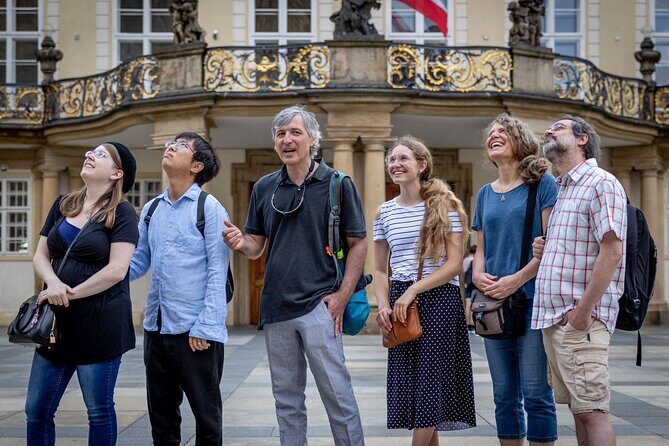
Prague Castle can overwhelm first-time visitors. You see towers, courtyards, churches, lanes, and walls—and it’s hard to know what matters most. This is where a private guide helps: instead of scanning your phone for facts, you get a guided route that explains how the place worked and why it changed over centuries.
The tour is built around one key idea: the castle complex isn’t one style. It’s a stack of time periods you can actually walk through. As you move from one stop to the next, you start to notice architectural fingerprints—from Romanesque solidity to Gothic drama, then Baroque and Rococo flourishes, plus Renaissance planning and Neoclassical balance. It’s like learning a visual language while you’re standing in the grammar.
You also get a historian guide, not just a reciter of highlights. That matters most for the tricky parts: battles, plunder, destruction, political power plays, and the way rulers shaped the grounds. The stories make the buildings feel less like museum props and more like evidence.
You can also read our reviews of more walking tours in Prague



Meeting Up on the Hill: How the Start Really Works

Your guide meets you either at a centrally located accommodation or in Prague’s Lesser Town, depending on where you’re staying. If you’re picked up, you’ll travel from there by metro, tram, or walking when stops are close. If you’re not doing pickup, the default meeting point is Bagel Lounge Malostranská at Letenská 118/1, 118 00 Praha 1-Malá Strana.
There’s also a practical detail that can save time: tickets are provided if you don’t have a pass. That doesn’t replace the Prague Castle entrance fee (which is separate), but it can reduce last-minute friction.
Because the meeting point is near a well-known area, I like the flexibility here. You’re not stuck hunting for a random address on a hilltop before you even start. If you have a tight schedule, morning departures can feel smoother for logistics; if you’re trying to dodge the busiest hours, an afternoon start can help.
The 3-Hour Core Circuit: Prague Castle, Royal Gardens, Moat, and Major Buildings
You’ll head uphill to Prague Castle on Hradčany Hill, then follow a route that focuses on what gives the complex its identity. Expect walking among courtyards and viewpoints, plus a steady rhythm of explanations as you go.
This stop is the tour’s backbone and the main reason it’s a good value as a private experience. The castle complex is often approached like a checklist—cathedral, lane, done. Here, the guide connects the dots between structures and events, including how artillery damage, marauding armies, and later neglect affected what you see today.
Walking the architecture timeline in real space
As you stroll, you’ll be shown examples across multiple periods, including:
- Romanesque
- Gothic
- Baroque
- Rococo
- Renaissance
- Neoclassical
The useful part isn’t memorizing terms. It’s learning how to spot the style cues. Once you know what to look for, St Vitus and other buildings stop feeling repetitive. They become different solutions to different times’ ideas of power, faith, and art.
Royal Garden and Stag Moat
You’ll pass key outdoor areas like the Stag Moat and areas of the Royal Garden, where the setting itself helps with understanding. Moats and garden spaces aren’t just scenery. They were part of defense and palace life, shaping how people moved through the complex.
This is also where you’ll feel the “castle as a whole” scale. Even before the big interior stops, you start seeing why this place is repeatedly described as one of the world’s largest castle complexes.
You can also read our reviews of more private tours in Prague






Royal Garden Highlights: Ball Game Hall and Queen Anne’s Summer Palace
Two short stops make this part fun, because they add a lighter, human angle to the heavy political themes.
Ball Game Hall in the Royal Garden
You’ll stroll past the Ball Game Hall, a Renaissance structure associated with sporty aristocrats playing games with imperial presence. The tour also points out a Renaissance sgraffito showing allegories of virtues and of arts and sciences.
This stop is quick, but it’s clever. It shows that the palace wasn’t only ceremony and power. It was also leisure, education, and public-facing symbolism.
Queen Anne’s Summer Palace
Then you’ll reach Queen Anne’s Summer Palace, described as one of the purest Renaissance buildings outside Italy. It was commissioned by Ferdinand I in the mid-1500s, later converted into an astronomical observatory by Rudolf II.
The science connection is where this stop becomes memorable. The tour doesn’t just say Kepler and Brahe were there—it helps you understand why a palace setting could also be a place for observation and study. You’ll also hear that the emperor himself died there after losing his royal title.
If you like Prague not only as a city of spires but also as a place where ideas mattered, this is one of your payoff moments.
St Vitus Cathedral: Gothic Drama and Czech Royal Power
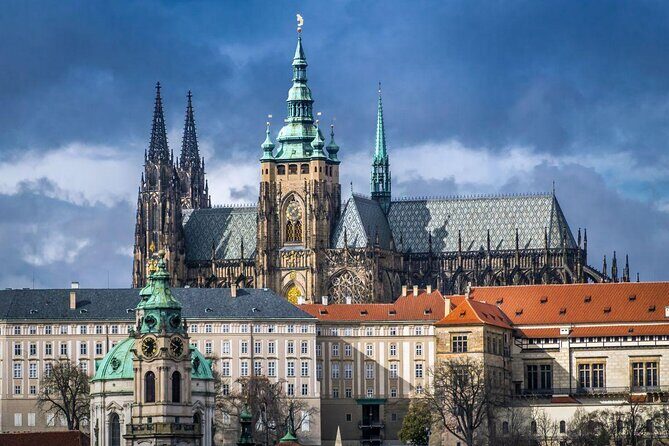
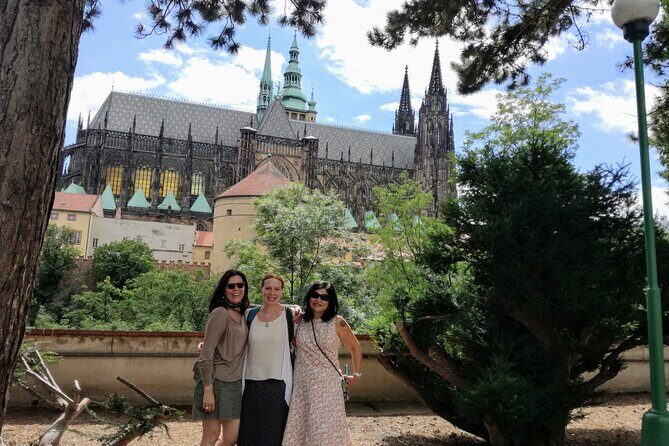
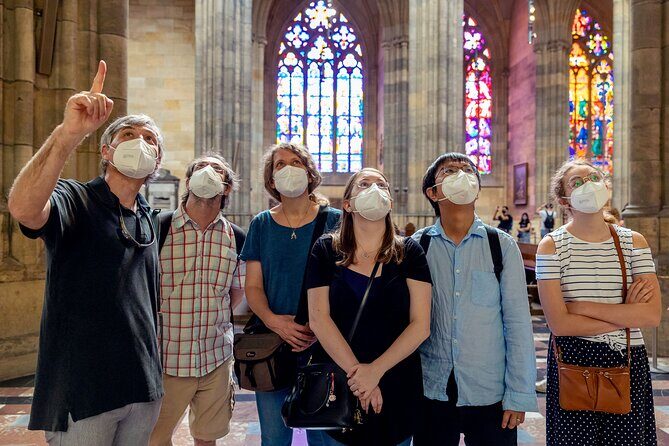
St Vitus Cathedral is the tour’s “big interior” stop, and it’s one of the main reasons people choose the castle complex in the first place. The cathedral is monumental and Gothic, with construction spanning a long timeline—founded in the 1300s and completed roughly 600 years later in the 1800s.
You’ll also learn what makes it politically important: it’s the site of the royal crypt for Czech sovereigns and patron saints. That adds weight to the architecture. You’re not only looking at a masterpiece of style; you’re standing inside a place tied to rulership and memory.
What to look for inside
The tour highlights:
- the Baroque tomb of St. John of Nepomuk, cast in silver
- the Gothic St. Wenceslas Chapel, housing relics of the saint
St Vitus can feel like a lot for a short visit. The guide helps by directing your attention to meaningful features rather than letting you wander and miss the key layers.
Practical note: this stop benefits from patience. Even if you’re not a cathedral person, the guided focus helps you get value without turning the interior into a random walk.
Old Royal Palace and Vladislav Hall: Coronations, Tournaments, and a Dark Spark
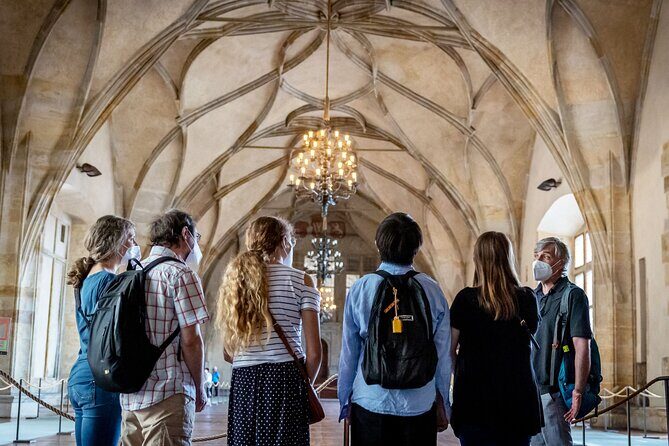
Next up is the Old Royal Palace and the star interior here is Vladislav Hall. You’ll be told it was built in the late 1400s, mixing late Gothic with Renaissance elements. It also hosted coronation celebrations, banquets, and even knights’ tournaments.
A detail I’d treat as a must-see moment: the hall design included a Riders’ Staircase built for mounted entrances. When you learn that, you stop seeing the staircase as decoration and start seeing it as stagecraft.
The defenestration story
The tour also takes you to the Ludwig Wing, where you’ll hear about the window from which members of the Czech Estates defenestrated Austrian governors and their scribe. That event helped spark the Thirty Years’ War—painted as one of history’s most destructive conflicts.
Even if you only remember one political story from the castle, this one works because it links a specific architectural feature (a window) to a real turning point. You can stand where the story happened and understand why it became a symbol.
St George’s Basilica: A Romanesque Reset After the Gothic Push
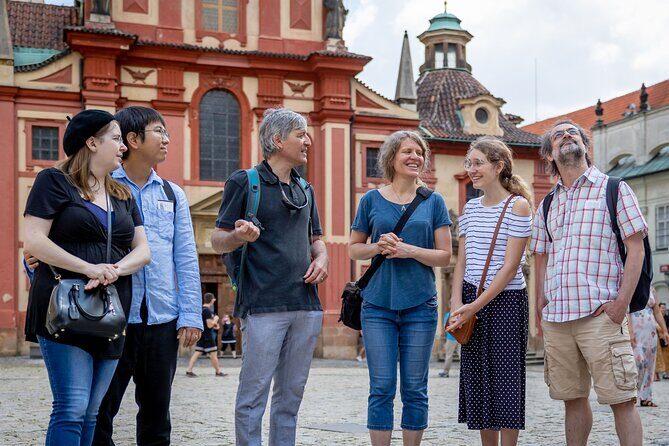
After St Vitus, St. George’s Basilica feels like a palate cleanser. It’s a Romanesque basilica from the 1100s, and the tour encourages you to compare it directly to what you just saw.
That comparison is the whole point. Gothic interiors often impress through height and drama; Romanesque can feel more grounded and solid. When your guide points out the contrast as you move between sites, it helps your brain organize what you’re seeing instead of treating each church as separate.
This stop is short, so it’s especially good if you’re trying to fit a lot into limited time.
Golden Lane: Miniature Rooms, Old Guards, and a Dungeon Connection
Then you’ll walk through Golden Lane, a quaint narrow street built in the 1500s to house Rudolf II’s castle guards. It’s one of those places where size does a lot of the storytelling. The diminutive scale makes you imagine everyday life more easily than the big ceremonial spaces do.
You’ll step into small rooms that today are mostly souvenir shops. The tour also points out that there’s a museum of medieval armor accessible from Golden Lane, plus a connection to Dalibor Tower, which was used as a dungeon.
The balance here is good. Golden Lane is easy to treat like a shopping lane, but with a guide you learn the context behind the walls and doors. If you like small, atmospheric corners of cities, this can be the part you remember even after the grand cathedral fades.
One small consideration: Golden Lane is popular. If you’re sensitive to crowds, keep your expectations realistic and lean on the guide’s pacing and timing choices.
Pricing and Value: What You’re Paying For (and Why It Can Be Worth It)
At $397.36 per group for up to 10 people, the headline price looks steep if you’re thinking in per-person terms. But the pricing model matters: it’s a private tour. If you’re traveling with family or friends, the cost can drop dramatically per head compared to booking separate guides.
Also, this is priced for quality time. You’re getting a historian guide for about 3 hours, and the itinerary covers multiple major stops inside one coherent circuit. The entrance fee for Prague Castle is separate, and adults pay CZK 450 (students and seniors CZK 300). So your total cost depends on how many people are in your group and which category you fit.
My practical take: this tour becomes a strong value when you want meaning, not just movement. If you enjoy asking questions, want help interpreting architecture, and don’t want to spend your limited time figuring out what to prioritize, a private historian guide is often the cheapest way to avoid wasted hours.
If you’re traveling solo on a strict budget, you might decide the entrance fee + private guide cost is more than you want to pay. But if you can spread the group cost—or you care deeply about understanding the castle’s layers—this is the kind of experience that earns its price.
Tips That Make the Experience Feel Easier
I’d go in with a couple expectations that keep the tour enjoyable.
First, plan for a lot of walking. The route climbs and connects several areas of the complex, so wear shoes you’d be happy to walk in for a while. If you bring a jacket, do it too—outdoor areas can feel cooler than you expect, especially in the open courtyards and garden sections.
Second, use the private format. If you have a specific interest—architecture styles, royal history, or the big dramatic events—tell your guide early. The tour can be customized, and you’ll get more out of your time if your guide knows what to emphasize.
Third, ask about line management and route flow. One small but useful idea: some guides have been able to route you through quieter garden ways to reduce friction. Another practical option that can help with pacing is starting higher up and working down with transit support. Even if you don’t know the exact method, you can ask your guide what will save time on the day.
Who This Tour Fits Best
This is a great fit for:
- first-time visitors who want a high-impact orientation to Prague’s most famous complex
- groups up to 10 who want private pacing instead of a crowd schedule
- people who like history told with specific place-based details
- anyone who enjoys architecture and wants help identifying styles in context
It may feel less ideal if you:
- want a very short visit only for a single attraction
- hate walking on hills or prefer minimal movement
- expect every part to be inside (this includes gardens and outdoor viewpoints)
Should You Book This Private Prague Castle Walking Tour?
If you want the fastest path to understanding Prague Castle—and you don’t want your day to become a messy pile of photos—this private walk is a strong choice. The historian guide focus, the architecture-to-story sequence, and the ability to choose morning or afternoon make it feel designed for real time limits.
Book it especially if your group cares about details, or if you know you’ll be disappointed by a basic highlights tour. Pay the entrance fee, wear comfortable shoes, and ask your guide what to look for at each stop. With that approach, you’ll leave with a castle that finally makes sense, not just a castle you visited.
FAQ
How long is the private Prague Castle walking tour?
It runs for about 3 hours.
Is this tour private?
Yes. It’s a private tour/activity, and only your group participates.
What does the price include?
The tour includes a historian guide. Prague Castle entrance tickets are not included.
What are the Prague Castle entrance fees?
The listed entrance fee is CZK 450 for adults and CZK 300 for students and seniors.
Does the tour offer pickup?
Pickup may be offered from your central hotel or flat, or your guide meets you in Prague’s Lesser Town. If you don’t want pickup (or don’t respond with your address), you’ll meet at Bagel Lounge Malostranská.
Can I get a full refund if I cancel?
You can cancel for a full refund up to 24 hours in advance of the experience start time.