REVIEW · PRAGUE
Secrets of Prague Old Town: Self-Guided Puzzle Walk
Book on Viator →Operated by Questo · Bookable on Viator
A puzzle stroll turns Prague into a game. This self-guided walk strings together major landmarks with clues that push you to notice details you’d normally miss. You start in Wenceslas Square and finish at Prague Castle, with most stops free to enter and short “solve-and-go” moments built in.
I love how this turns sightseeing into something you can control. There’s no meeting up with a guide and no group herding—just your phone and a route—so you can pause for coffee or shop without feeling behind. I also like the value: at about $7.21 per person for roughly two hours, you’re basically buying a structured route plus context for top sites.
One thing to consider: it’s self-guided, so the experience depends on your mood for puzzles and reading signs. If you want a traditional, spoken narrative the whole way, this may feel a bit “do-it-yourself.”
In This Review
- Key highlights you’ll feel right away
- How this “puzzle walk” changes the way you see Prague
- Starting at Wenceslas Square: the game’s first “history hit”
- Old Town churches with puzzles: Our Lady of the Snows and the Tyn Cathedral
- St. Giles and the Mozart fact you can actually use
- St. Martin in the Wall and the cursed Iron Knight legend
- Clementinum’s Italian Chapel and the Old Town Bridge Tower showdown
- St. Nicholas steps, Kafka’s neighborhood, and the walk into Prague Castle
- Astronomical Clock details and the Lesser Town Bridge Tower legend
- What to wear and how to pace yourself in about 2 hours
- Price and value: $7.21 for major sights plus direction
- Who this puzzle walk suits best (and who may want something else)
- Final verdict: should you book Secrets of Prague Old Town?
- FAQ
- Do I need a guide with this experience?
- Does it work without internet?
- How long does the puzzle walk take?
- What language is it offered in?
- Where does it start and where does it end?
- Are entry tickets included?
- Can I start at any time during the day?
- Is it private or shared with other groups?
- What’s included on my phone?
- Is cancellation free?
Key highlights you’ll feel right away
- Private, no-human-contact format so you can move on your own and avoid crowd stress
- Offline play means you’re not stuck hunting for signal between stops
- Fast route with smart stops that covers Old Town, Malá Strana, and Prague Castle in about two hours
- Most entrances are free at the stops themselves (the Astronomical Clock is the main exception)
- Clever history nuggets built into each location, like Jan Palach’s memorial plaques and the Orloj’s astronomical details
- Stairs-and-views moments that reward you if you’re up for climbing—like the 215 steps at St. Nicholas Church
How this “puzzle walk” changes the way you see Prague
Prague is famous for big postcard views, but it’s the small stuff that makes it memorable: a vault height you wouldn’t guess, a legend tucked into a corner, or a tower detail that explains itself only if you look twice. This tour uses that idea. You don’t just “arrive” at places—you’re nudged to solve a clue, then you get the next step.
For me, the best part is that it keeps you moving in a sensible order. Instead of randomly bouncing between Old Town and Castle, you follow a logical route that gradually builds from street-level squares and churches into iconic viewpoints and the Castle complex.
It also fits real travel life. You can start at any hour during the allowed window, take a break, and resume later. That matters in Prague, where weather changes fast and your feet get tired at the exact wrong moment.
You can also read our reviews of more walking tours in Prague



Starting at Wenceslas Square: the game’s first “history hit”
Your tour begins at Wenceslas Square (Václavské náměstí), which is more of a long boulevard than a classic little plaza. It stretches about 750 meters and once served as a horse market centuries ago. Today it’s Prague’s nightlife and entertainment lane, so it’s a practical place to start—easy to find, full of shops and food, and not hard to build your day around.
What makes this first stop work well is that it’s both easy and meaningful. If you climb the steps to the National Museum, you get a view down the square. Then, near St. Wenceslas’s statue, you’ll notice commemorative plaques on the ground, including one dedicated to Jan Palach, who protested the Soviet invasion by setting himself on fire.
In other words: the game starts you in the middle of a street that has carried major Czech events, not just tourist foot traffic. Once you’re oriented, you get instructions to keep going.
Old Town churches with puzzles: Our Lady of the Snows and the Tyn Cathedral
From Wenceslas Square, the route heads into the Church of Our Lady of the Snows. This is tied to King Charles IV’s grand plans for a huge Gothic church, but the Hussite Wars interrupted everything—so what you see is “incomplete” by design history. Still, the vault reaches 34 meters, which is the highest in Prague. Nearby, Franciscan monks later took over the abandoned complex from Emperor Rudolph II and built the surrounding monastery and library in Baroque style.
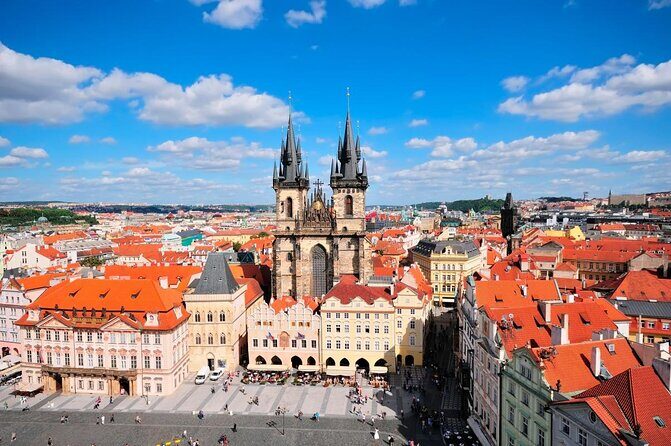
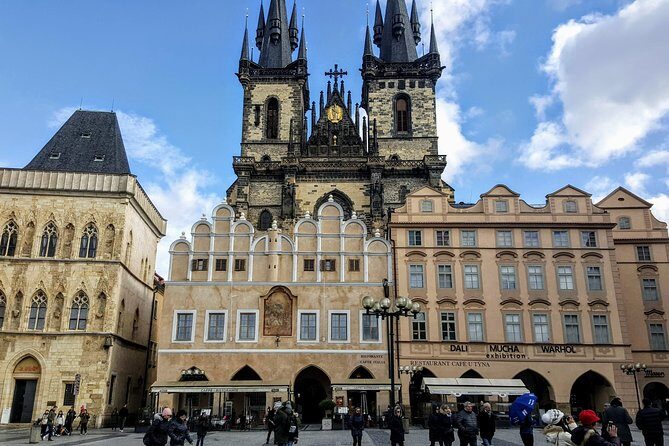
Next up is the Church of Our Lady before Týn (Týnský chrám). This place is known for its twin towers and the Madonna statue between them. There’s a fun detail here: the towers aren’t identical, because one is slightly sturdier to represent the man as the stronger side of the family. Inside, you can look for a prized organ from the second half of the 17th century and wander among tombstones spanning medieval, Gothic, and Baroque periods. The game also leads you toward a specific burial tied to an astronomer connected to Emperor Rudolf II’s court—solve the local challenge and you’ll learn the name.
Practical note: these are churches, so go in with a calm pace. The “puzzle” makes you look, but you still get the quiet payoff—vault shapes, tombstone markings, and the way light behaves inside.
St. Giles and the Mozart fact you can actually use
St. Giles Church is part of the Dominican monastery complex in Old Town, with Romanesque roots later rebuilt in Gothic form. Even if Gothic architecture isn’t your thing, the human stories here make it stick.
The big one: Mozart and Constanze got married here. Not many churches can claim that, and it gives you a reason to slow down and pay attention to what’s around the altar and within the nave.
Inside, you’ll find rich stucco decorations and frescoes on the vaults, plus the Altar of the Painful Virgin Mary. There are also apostle statues created by the Czech sculptor Ferdinand Maxmilian Brokoff. If you like music, you might even catch classical or religious concerts held in the church—though the tour itself doesn’t advertise tickets as part of the game.
This stop is also a good example of why the puzzle format works. Instead of reading a generic sign, you’re pushed to look for a specific answer, so you don’t “walk through” and miss the best details.
St. Martin in the Wall and the cursed Iron Knight legend
St. Martin in the Wall Church has a name with a clue in it—literally. It sits where the church wall touched the south fortification wall, so the church earned its “in the wall” label. Architecturally, it starts as Romanesque in the settlement of Ujezd and later gets rebuilt in Gothic under Charles IV.
The story gets interesting in 1414: for the first time, the sacrament was given in two kinds—bread and wine in a cup—rather than belonging only to priests. Later, in the 18th century, the church was canceled and repurposed as apartments and shops. Today, it’s still a working part of the city’s religious and cultural map, with Sunday worship and possible classical concert programming.
Then the route shifts from “church time” to a more Prague-style legend at the Iron Knight. Prague loves stone-and-story statues, and this one comes with a dark romance. The cursed, faceless knight is believed to have killed his lover in a fit of rage and was turned to stone as punishment. The legend says he could be freed by the pure love of a woman, but only once every hundred years.
The game nudges you to find the right clue, so you’ll be looking at the statue with purpose rather than just taking a quick photo.
You can also read our reviews of more guided tours in Prague



Clementinum’s Italian Chapel and the Old Town Bridge Tower showdown
The Clementinum complex area is a great mid-walk change of pace. You’ll go to the Vlašská kaple Nanebevzetí Panny Marie—also known as the Italian Chapel of the Assumption of the Virgin Mary. It was built at the end of the 16th century for early Italians living in Prague, and it stands out with its oval plan, which was uncommon in Bohemia at the time.
Right nearby is the Cathedral of St. Clement, a Baroque church with an especially elaborate interior. Even if you don’t go deep inside, this area’s scale is impressive: the Jesuit-founded Clementinum covers about two hectares and functions as an education and culture center. It’s the second biggest building complex in Prague after the Castle.
Then you’ll reach the Old Town Bridge Tower. This Gothic structure once acted like a triumphal arch for kings of Bohemia during coronation processions on the Royal Way—starting from the Old Town and leading up to St. Vitus Cathedral at Prague Castle. It also served a military purpose as part of the defense system protecting the Old Town from northern invaders, with about 100 stonemasons involved in the full construction and decoration.
If you like when a city’s skyline explains itself, this is one of those stops.
St. Nicholas steps, Kafka’s neighborhood, and the walk into Prague Castle
St. Nicholas Church is one of the largest churches in Prague and was founded by Jesuits. Today it belongs to the Czechoslovak Hussite Church. There’s also a Kafka connection: the house next to the church stands on the birthplace of writer Franz Kafka.
The big reason this stop works on a puzzle walk is the payoff for your effort. If you climb the 215 steps, you can see views over Lesser Town and across the Vltava River to the Old Town. At night, Old Town Square is lit by lanterns, which is exactly the sort of Prague moment that makes a climb feel worth it. The interior can be visited every day except Sundays, when Holy Mass is usually held.
Finally, the tour ends at Prague Castle. This part is built for impressions. At Matthias Gate, you’ll see the Wrestling Titans—also called Fighting Giants—two outdoor sculptures that mark the start of the Castle courtyards. Prague Castle used to be the seat of the Kings of Bohemia and is where they were buried. Today it’s the office site of the Czech Republic president.
Timing note that helps: you can watch the changing of the presidential guards every hour at the three main entrances to the Castle. That gives you a natural “wait a bit” moment near the end, which many puzzle walks lack.
Astronomical Clock details and the Lesser Town Bridge Tower legend
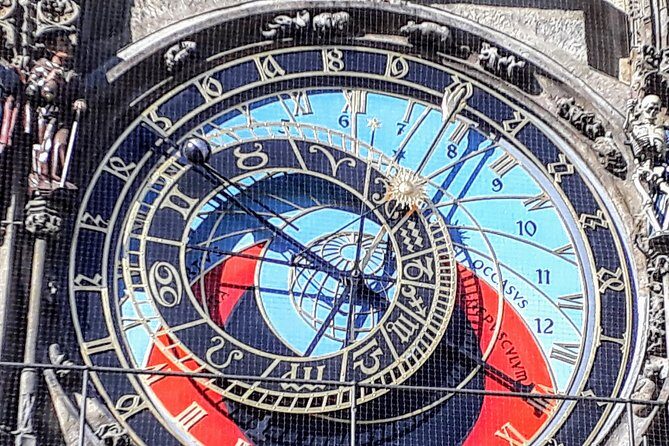
After Prague Castle, the route flows back toward Old Town’s classic icon: the Old Town Hall with the Astronomical Clock (Orloj). This is the third-oldest astronomical clock in the world and has been a Prague gem since the beginning of the 15th century. There’s also a legend: if the clock were ever broken beyond repair, the city would suffer.
What makes the Orloj more than just a famous clock face is the information it displays. Besides telling time, it shows the position of the Sun and Moon and also includes zodiac details. The clock was heavily damaged in World War II, when Czechs fought occupying Nazi forces, but it was repaired and started working again in 1948.
One practical heads-up: the Astronomical Clock entry isn’t included. So if you’re trying to keep the total cost low, plan for that separate ticket.
Your final stop is the Lesser Town Bridge Tower on the Malá Strana side, at the end of Charles Bridge. These towers differ from their Old Town counterpart. The Lesser Town towers weren’t decorated; they have Romanesque reliefs inside instead. The smaller tower once formed part of the fortification system in the days of the Judith Bridge.
Here’s the legend: a missing stone sits in an empty spot. Chroniclers claimed ravens perched on it, causing it to land on the head of King Václav’s favorite knight. The knight survived many battles, but a simple stone killed him instantly. The king didn’t replace the stone to honor the knight’s legacy. The game ends with you learning the story behind the spot.
What to wear and how to pace yourself in about 2 hours
This is a brisk sightseeing format. Stops are brief, and the game keeps you moving from place to place, usually for around 5 minutes each, with the clock stop taking longer.
Wear shoes you trust. Some stops come with stairs or climbing opportunities—like the 215 steps at St. Nicholas. You can choose how hard you want to lean into views: do the climb for the panorama, or keep it lighter and still enjoy the church interior.
Also, build in slack. Even though the route is structured, Prague is full of side distractions: a shop window, a pastry stop, or a quick pause when the cathedral light looks perfect. The tour’s design lets you stop and resume, so you don’t have to “finish perfectly” to get value.
Price and value: $7.21 for major sights plus direction
At about $7.21 per person, this isn’t “pay for a fancy guided narration.” It’s payment for structure: a routed walking loop, puzzle prompts at each stop, and short historical context where you actually need it—while you’re standing in front of the thing.
The value gets better if you’re:
- traveling as a couple or small group,
- trying to hit key landmarks in limited time,
- and want independence over a schedule.
The Astronomical Clock ticket is the main extra cost you should anticipate. But most other stops list free admission, so your baseline spending stays predictable.
Who this puzzle walk suits best (and who may want something else)
This works especially well if you like:
- self-paced travel with no human contact,
- a route that covers Old Town to Castle without overthinking it,
- and “look closer” history where the facts are tied to what you can see right then.
It might not be ideal if:
- you dislike puzzles or reading on your phone,
- you want a live guide explaining every site in depth,
- or you’re hoping for lots of long indoor time at each stop.
If you’re happy to treat it as a focused walk with mini-challenges, you’ll likely find it satisfying.
Final verdict: should you book Secrets of Prague Old Town?
I’d book it if you want an efficient, private way to experience Prague’s top landmarks while still feeling a bit curious. The biggest reasons are the offline, flexible format and the way the game pushes you to notice details at places like Wenceslas Square, Týn Church, St. Nicholas, and the Orloj.
Skip it only if you know you prefer traditional guided tours with a voice guiding every step. Otherwise, this is a smart buy for a short Prague window—especially when you want to see a lot without the crowd pressure.
FAQ
Do I need a guide with this experience?
No. This is a self-guided game, so there’s no physical tour guide included.
Does it work without internet?
Yes. You can play offline and you do not need an internet connection to play the city game.
How long does the puzzle walk take?
It takes about 2 hours.
What language is it offered in?
It’s offered in English.
Where does it start and where does it end?
It starts at Wenceslas Square (Václavské nám., 110 00 Praha-Praha 1) and ends at Prague Castle (119 08 Prague 1).
Are entry tickets included?
Most stop admissions are free. The Old Town Hall Astronomical Clock is listed as admission ticket not included.
Can I start at any time during the day?
Yes. The experience is always available to book, and you can start at any hour. The stated daily time window is Monday–Sunday from 5:00 AM to 9:30 PM.
Is it private or shared with other groups?
It’s private. Only your group participates.
What’s included on my phone?
You’ll use a mobile ticket, and you’ll follow clues and puzzles at each stop to get directions to the next location.
Is cancellation free?
Free cancellation is available if you cancel at least 24 hours in advance for a full refund.